MRR Calculation Methods and Why Teams Get Different Answers
Different teams define MRR's inputs differently, creating conflicting numbers from the same formula.

Monthly Recurring Revenue is a disputed definition wearing the costume of a math problem. You can teach the formula itself, active subscribers multiplied by average revenue per account, in five minutes, and almost no team gets the multiplication wrong. What they get wrong, or rather what they never agree on in the first place, is what belongs inside each of those two variables. MRR has no governing body. It is not defined by the Financial Accounting Standards Board, and it carries no GAAP standard the way revenue recognition does. Baremetrics puts it this way: MRR is "all of your recurring revenue normalized into a monthly amount," a description of a standardization exercise, not an accounting procedure. Stripe draws a related line, treating MRR as a measure of predictable recurring income that stands apart from total revenue, which can include one-time fees, hardware sales, and setup charges. Because no outside authority settles what counts as active, what counts as recurring, or which month a given dollar belongs to, every team answers those questions on its own, often without realizing a question was asked. The formula is agreed upon everywhere. The inputs feeding it are agreed upon almost nowhere, and that gap is where every discrepancy in this article begins.
The five components of MRR
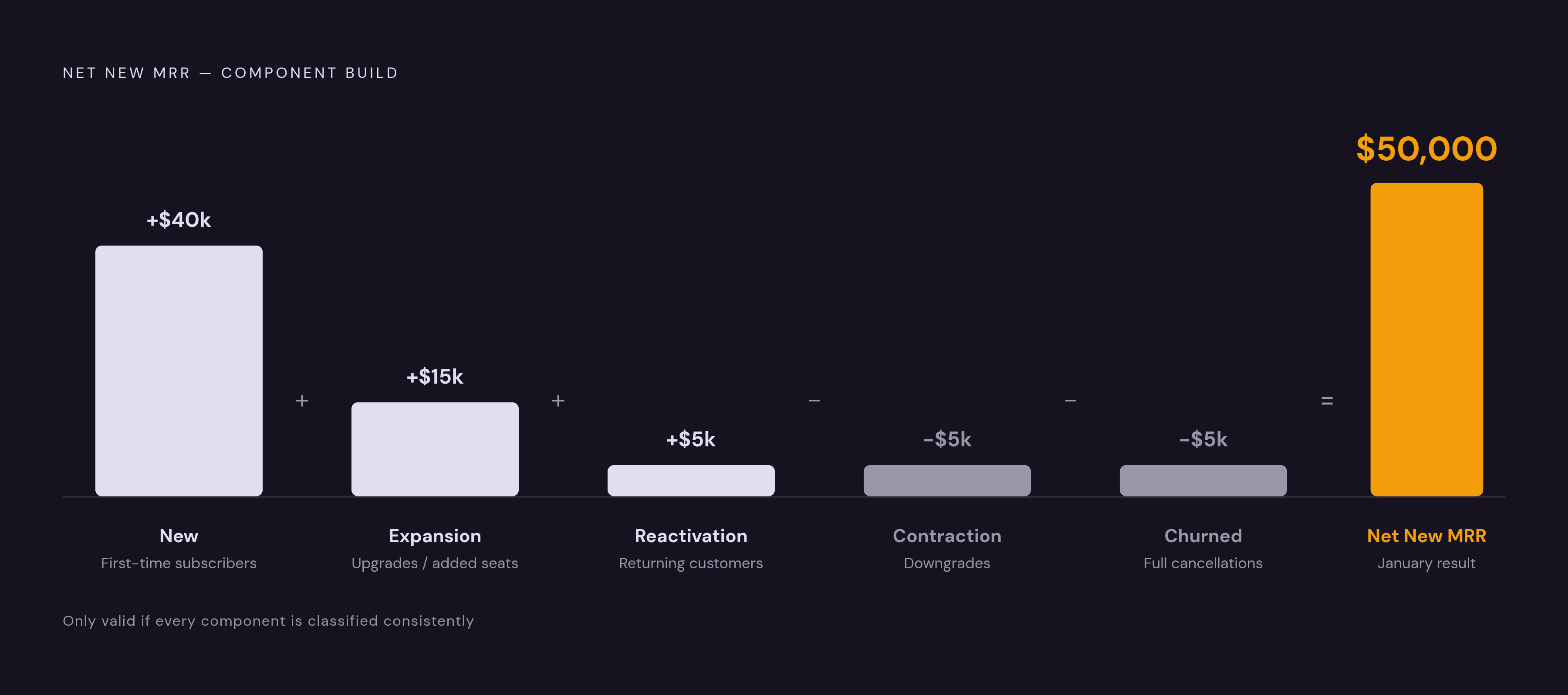
A single MRR total tells you where revenue stands. It says nothing about how it got there. Most serious SaaS reporting breaks the number into five movement components: New, Expansion, Contraction, Churned, and Reactivation. Each one answers a different question about change over time, but each one also carries a classification call that two reasonable teams can resolve in opposite ways. New MRR covers revenue from customers subscribing for the first time, but if a customer who canceled eighteen months ago signs up again, you get a live argument over whether that revenue counts as New or something else. Expansion MRR captures the additional revenue existing customers generate through upgrades, added seats, or add-ons, and it is easy to underweight. Kissmetrics calls it "often the most overlooked component," even though for mature SaaS companies it can exceed New MRR. Contraction MRR covers revenue lost to downgrades that fall short of full cancellation, so you should treat it as a leading indicator of future churn, not just a routine accounting adjustment. Churned MRR, the revenue lost when a customer cancels entirely, has to be tracked apart from contraction, because a customer who leaves and a customer who merely scales back are telling you two different stories about the business. Put all five together and Net New MRR equals New plus Expansion plus Reactivation, minus Churn and Contraction. Saber's 2026 analysis walks through a worked January example that lands on $50,000 in Net New MRR from that exact sum. That number only means what it claims to mean if every input feeding it was classified the same way every month, by every team pulling it.
Billing interval normalization and the most common MRR discrepancy
No other single error produces as much disagreement as how a team handles annual and multi-month contracts. Take a customer who signs a one-year plan and pays the full amount upfront in January. One way to handle that payment is to book the entire sum as January's revenue, which makes January look unusually strong and every month afterward look like a cliff, even though nothing about the underlying business changed. The other way is to divide that same payment by 12 and credit one-twelfth of it to each month across the contract term, which is what the normalization rule actually calls for. Saber states the rule without ambiguity: annual contracts divide by 12, quarterly contracts divide by 3, giving every team a consistent monthly basis no matter how a customer happens to be billed. GoHighLevel's calculator documentation backs the same approach: it represents even upfront annual contracts as one-twelfth of their value each month, so the metric stays consistent across the customer base. The failure mode runs in both directions. Booking the full annual sum in the month it arrives inflates that month's MRR and manufactures a phantom collapse in the months that follow. Spreading the payment correctly but anchoring it to the wrong date, say, the date the payment cleared rather than the date the subscription actually started, shifts the number by days or weeks and produces a third, equally plausible-looking figure. A finance team watching billings cash and a product team querying subscription records can run the same customer through this logic and land on two different monthly numbers, and each one is internally consistent, yet wrong relative to the other.
Four other definitional choices that silently split a team's MRR number
Billing interval normalization is the most visible source of disagreement, but it is only one of several decision points hiding inside the MRR formula, and a team that fixes this one and stops there will still find its numbers drifting apart. One-time fees are the clearest case: setup charges, implementation work, and professional services are not recurring revenue by definition, and folding them into MRR makes the subscription base look bigger than it actually is. Kissmetrics states the exclusion directly, noting that "one-time fees, implementation charges, and variable usage overages are not part of MRR." Free trials present a related trap. A customer sitting in a trial period has not converted to a paying relationship yet, and counting trial activity, even a zero-dollar placeholder row, as MRR overstates how many people are actually paying. Baremetrics flags this as a recurring mistake teams make when they pull numbers straight from a subscription table. Discounts cut the other way: a customer paying a discounted rate after applying a coupon contributes only what they actually pay, not the list price the sales page quotes, and ignoring that distinction overstates real revenue. Kissmetrics lists this among the most common calculation errors teams make. Usage overages round out the list, variable charges that move with consumption rather than with the subscription itself, and including them treats unpredictable revenue as if it were the predictable kind MRR exists to measure. None of these four decisions is hard to make correctly. The trouble is that each one has to be made on purpose, and a team that never writes the decision down will apply it inconsistently from one report to the next.
Why finance, sales, and product see different numbers
None of the three functions pulling an MRR number from the same business is making a mistake, exactly. Each one is applying a logic that makes complete sense from where it sits, and that is precisely what makes the resulting disagreement so hard to resolve. Finance works from billings and accounting revenue, so it treats MRR as a backward reconciliation built from invoices and shaped by revenue recognition rules that were never designed with subscription periods in mind. Sales works from contract value, tends to count revenue at the moment a deal is signed, and is prone to including committed expansion that has not actually gone live yet, along with a weaker habit of backing out discounts applied after the deal closes. Product works from the subscription database itself, counting active records as it finds them, which can mean paused accounts, lingering trial slots, or rows nobody cleaned up after a customer churned months ago. Baremetrics draws the line that matters here: MRR is not GAAP-compliant and was never meant to double as an accounting figure, so MRR and accounting revenue will diverge any time a team treats them as interchangeable. None of this is a data quality problem waiting on better tooling to fix it. It is a language problem. When two executives can answer the identical question about the same KPI using two different pieces of internal logic, the business does not have a metric. It has a standing debate that happens to produce a number.
What MRR components hide when the definition is inconsistent
An inconsistent MRR definition does more than generate disagreement between departments. It can actively hide the fact that a business is getting worse. When Churned MRR and Contraction MRR get folded into the total instead of tracked apart from it, the component breakdown itself can show a flat or even rising MRR line for a business that is adding new customers while steadily losing existing ones, with nothing on the surface suggesting a problem. Kissmetrics is direct about why the separation matters, noting that tracking churned MRR apart from contraction MRR "helps you distinguish between customers who leave entirely versus those who downgrade." A customer who downgrades today is a meaningfully higher risk to cancel tomorrow, and a blended number erases that signal. A related distortion occurs when Reactivation MRR gets folded into New MRR: the business looks like it is winning new logos when it is actually recovering customers who had already left once, a different and generally weaker growth signal than fresh acquisition. A team that never splits its MRR this way will not see deterioration until it has already compounded for several reporting cycles, which is exactly the blind spot the component breakdown exists to catch. A team that watches total MRR and Net New MRR without tracking gross retention alongside them cannot tell a business expanding through genuine growth apart from one that is growing in spite of heavy churn underneath. A single governed definition has to cover the components, not just the headline total, or the number will keep looking healthier than the business actually is.
Pre-agreeing on one definition eliminates the discrepancy before the calculation runs
Every discrepancy covered so far traces back to the same root cause: teams calculate MRR from definitions nobody ever wrote down or agreed on, and those implicit definitions drift apart the moment more than one person is responsible for producing the number. The fix is not a better formula, and it is not a faster data pipeline. You have to govern the definition itself, and settle it before anyone runs a calculation. That governance has to cover, explicitly and in writing, what counts as an active subscription, how each billing interval gets normalized, which fee types are excluded, how trial activity is treated, whether discounts apply at gross or net, and how reactivated customers get classified apart from new ones. Kissmetrics frames this kind of standardization as foundational rather than optional, describing a shared reference as something "whether you are a founder calculating MRR for the first time or a finance team trying to standardize your approach" needs in place from the start. If you govern the definition, finance and product can query entirely different systems and still land on the same number, because both apply the same classification rules to the same underlying inputs. Smaller teams sometimes object that this amounts to overhead they cannot afford yet, and if you are a one-engineer startup, building a full semantic layer at that stage probably is a distraction. The definition itself does not require infrastructure, though. It requires a written agreement, applied the same way every time, before any reporting tool touches the data. Skipping that step and automating reports anyway makes the problem worse rather than better: a broken definition that gets wired into a dashboard or a recurring report just distributes the wrong number faster, and the wrong number becomes harder to correct once people have already built decisions on top of it.
How a governed data layer enforces the definition
A written definition is the necessary first step, but it is not the last one, because a document that lives in a wiki page depends on every person remembering to follow it. The more durable fix is putting the definition into the data layer itself, pre-modeled into metrics that every consumer, whether that is a finance analyst, a product manager, or an AI agent with database access, pulls from the same calculation. This is the core argument for a semantic layer: one definition of a metric, expressed once and shared across finance, sales, product, and any automated system touching the data, removes "which MRR do you mean?" from the conversation permanently rather than resolving it meeting by meeting. Once the classification rules for billing interval normalization, fee exclusions, trial treatment, and discount handling are encoded at the model layer, nobody has to re-litigate them every time someone builds a new report or a new hire starts pulling numbers independently. If your team already runs on Supabase or native Postgres, you do not need to stand up a separate data warehouse or build an ETL pipeline from scratch. You can extend the analytical layer directly from Postgres and apply the agreed definition in place, without moving the data or altering the schema it already lives in. The stakes here are rising quickly as more of this querying gets automated: an AI agent pointed at a production database to answer "what's our MRR?" will apply no definition at all unless one has been enforced upstream, and it will simply return whatever the subscription table happens to contain, trial rows, one-time fees, and unnormalized annual payments included. A governed, pre-modeled dataset prevents that outcome by design, because the definition the business agreed on is the only version of the metric available to query.