Governed Datasets vs Live Database Queries for AI Agents
Governed datasets prevent agents from compounding bad data into bigger mistakes.
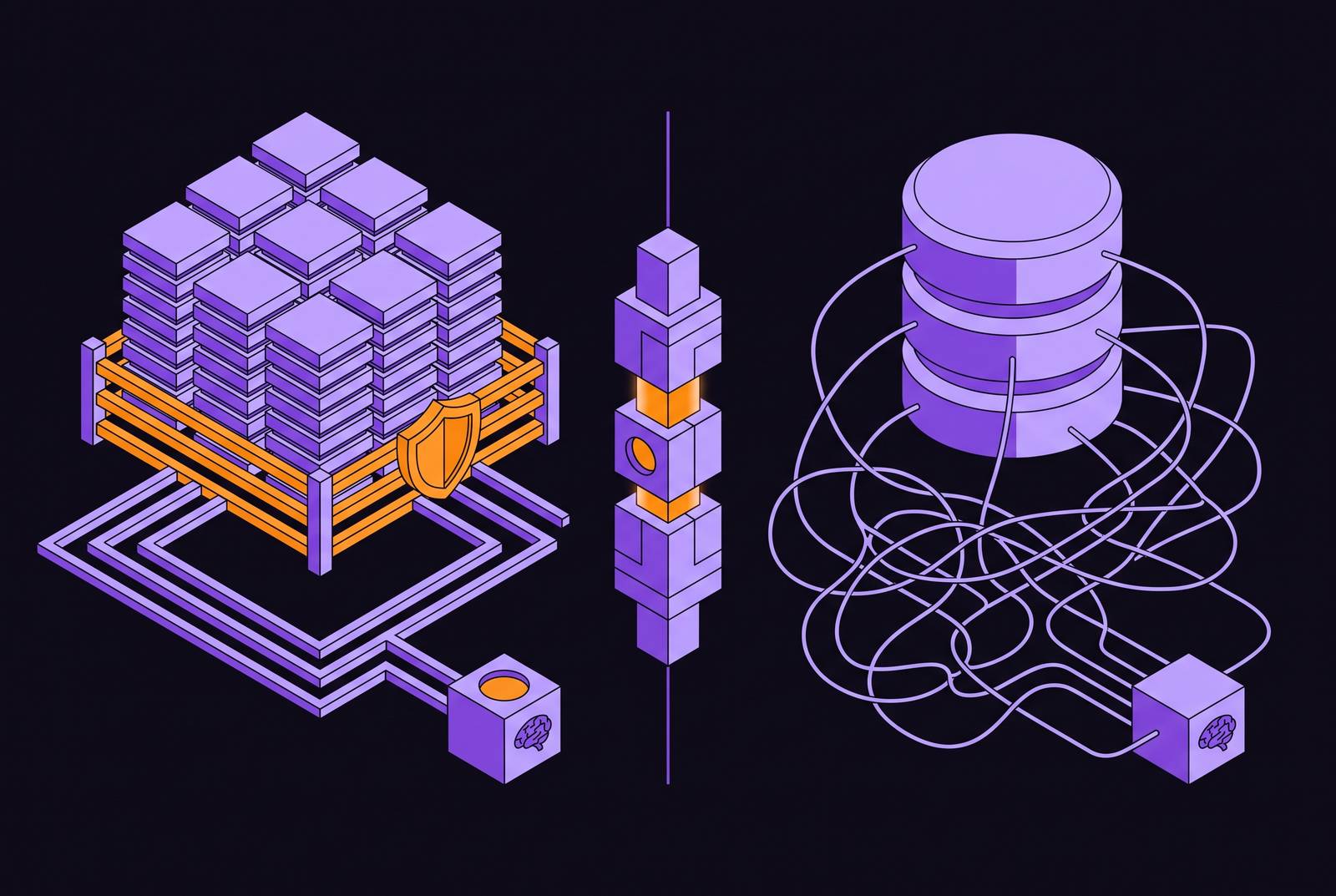
The risk in giving an AI agent direct access to a live database has nothing to do with whether the agent is careless. The entire premise of traditional data governance, a person reading an output and applying judgment before anything happens, collapses the moment an agent acts without that person in the loop. Traditional governance assumed a human checkpoint: someone runs a query, looks at the result, decides whether it makes sense, and only then takes action. Agents remove that checkpoint by design. They query, take the answer at face value, and act. The controls that used to live in a person's judgment now have to live somewhere else entirely: inside the data layer itself.
This changes what a wrong answer costs. When a human analyst gets a bad query result, there's a reasonable chance they notice something is off before they forward it to the CFO. An agent has no equivalent instinct. A wrong number gets acted on, and the action often triggers further autonomous steps that compound the original error. Three bad decisions can stack on top of one bad query before anyone realizes the first one was wrong.
The instinct to patch this with agent-level rules or careful prompt instructions fails for a related reason: any control placed outside the data layer is a control an agent can reason around or simply never encounter. Enterprise governance practice has already documented why application-layer access control breaks down once SQL is dynamically constructed by an agent rather than written by a developer and reviewed in a pull request: there is no practical way to test or review a query that didn't exist until the moment it ran. And the exposure isn't just operational. Least privilege is a specific legal requirement for systems handling personal data, grounded in the data minimization principle under GDPR Article 5(1)(c). An agent with unscoped database access creates regulatory exposure the moment it touches data it had no defined need to see.
Governed datasets versus live queries at the architectural level
A governed dataset is a pre-modeled, certified artifact, built with access control, ownership, and quality signals already attached, that an agent can query without ever touching the system of record. The distinction from a live query is mechanical. A live query hits the production database at the moment it's issued and returns whatever is there, under whatever permissions the connection happens to carry. A governed dataset is pre-calculated and schema-fixed before the agent ever calls it, and the scope of what it can return is set in advance.
Access control works differently, too. Instead of assuming that wherever the data lives determines who can see it, a governed dataset enforces scope at query time: every response is sized to the caller's actual permissions, and the context that comes back carries metadata about ownership, certification status, and data quality, so an agent can tell a trusted asset from a deprecated one rather than treating every table as equally authoritative. Format is part of what makes this work in practice. Structured, machine-readable formats like Parquet, with defined schemas and context-rich metadata attached, are what let an agent actually use a dataset operationally. And because aggregations run on a schedule ahead of time, the agent receives a calculated fact rather than performing a raw table scan at the moment of the question, which is also why these queries run fast and cheap compared to hitting a live production schema.
The strongest objection to this model is that pre-calculated data goes stale, and live queries don't. That's a fair concern, but it misstates the trade-off. The overwhelming majority of what agents are actually asked to do, metric delivery, KPI monitoring, report generation, trend analysis, tolerates freshness measured in minutes or hours without any loss of usefulness. Only a narrow class of operational decisions genuinely needs sub-second live data, and that class is much smaller than most teams assume when they default to raw access out of habit. The real trade-off isn't freshness against accuracy. Raw database access buys an agent maximum freshness at the cost of maximum exposure, and for nearly every reporting task that exposure is a price paid for a benefit the task never needed in the first place.
The semantic layer as MCP's governance boundary
The Model Context Protocol has become the standard way agents connect to external tools and data sources through a single consistent interface, and a July 2026 revision to the MCP spec introduced a stateless protocol core, letting any request land on any instance behind a plain round-robin load balancer and making MCP-fronted data layers viable to run at real production scale. That matters for adoption, but it doesn't change what MCP actually does. MCP handles transport and tooling. It says nothing about whether the data an agent receives through it is trustworthy.
The mistake many teams are making now is treating the protocol itself as a governance solution. An agent connected by MCP to uncertified tables doesn't become safer for being connected through a standard interface. It still returns confident, wrong answers with the same fluency it would use for correct ones, because MCP was never built to certify data, only to move it. The semantic layer beneath the protocol defines and certifies every operation an agent can call. Instead of exposing raw database tables through MCP, the server exposes semantic layer operations as the callable tools themselves: agents call pre-defined metrics, dimensions, and filters, not raw SQL against a live schema. The governance boundary becomes the interface. An agent simply cannot call an operation the semantic layer hasn't defined and certified. The boundary is enforced by what's available to call rather than by a policy someone hopes the agent follows.
Supabase's own published guidance on agentic Postgres use shows these failure modes in a concrete, widely-used platform. Supabase released an open-source Agent Skills package in early 2026, giving AI coding assistants PostgreSQL best-practice rules across eight categories, built specifically to address mistakes its own team had observed across hundreds of thousands of Postgres projects: missing indexes on foreign keys, RLS bypasses, table-locking migrations, connection pool exhaustion, and full table scans hidden behind ORM layers. That a team as close to Postgres internals as Supabase's felt the need to build this kind of guardrail package for agents is a direct validation of the structural argument: even a well-run, well-documented database still produces dangerous agent behavior without a governance layer sitting above the raw schema.
The single metric definition problem becomes catastrophic when agents report numbers
Every company with more than one reporting system eventually runs into the same problem: finance reports one MRR figure, product reports another, and nobody can fully explain why they differ. When a human encounters this, the result is friction, an exec team arguing about whose number is right instead of what to do about it, but the inconsistency at least gets noticed and debated.
An agent doesn't argue. It picks whichever version of the metric it happens to have access to, treats it as settled fact, and builds a board report, a Slack summary, or an investor update on top of it without flagging that another, contradictory number exists somewhere else in the organization. The failure compounds because the agent repeats it consistently: the same wrong figure appears in every output that draws from that source, delivered with the same confidence each time. And the damage isn't contained to the one bad number. Once a stakeholder catches even a single inconsistency in agent-generated output, confidence in everything else the agent has produced collapses with it, because the person reviewing it has no way to know which other numbers were quietly wrong in the same way.
The only way for an agent to serve as a reliable metric reporter is to connect to a governed context layer rather than raw enterprise data: one where semantic definitions are fixed in advance, so the same question returns the same answer regardless of which system or which agent asked it. A single definition of a metric, agreed on once and shared by every stakeholder, does more for an organization's decision-making than any dashboard feature, and a governed dataset enforces that single definition structurally. This discipline matters even before agents enter the picture. Early-stage companies are usually better served by tracking a small number of engagement and product-market-fit signals than by building an elaborate financial narrative, but whichever metrics a team chooses, those metrics need one canonical definition that any agent can inherit. Tracking too many indicators already produces analysis paralysis for human teams; an agent operating on ungoverned data makes it worse, because it will surface every available metric with equal confidence, with no sense of which ones actually matter.
The three enforced principles that make agentic data access safe in practice
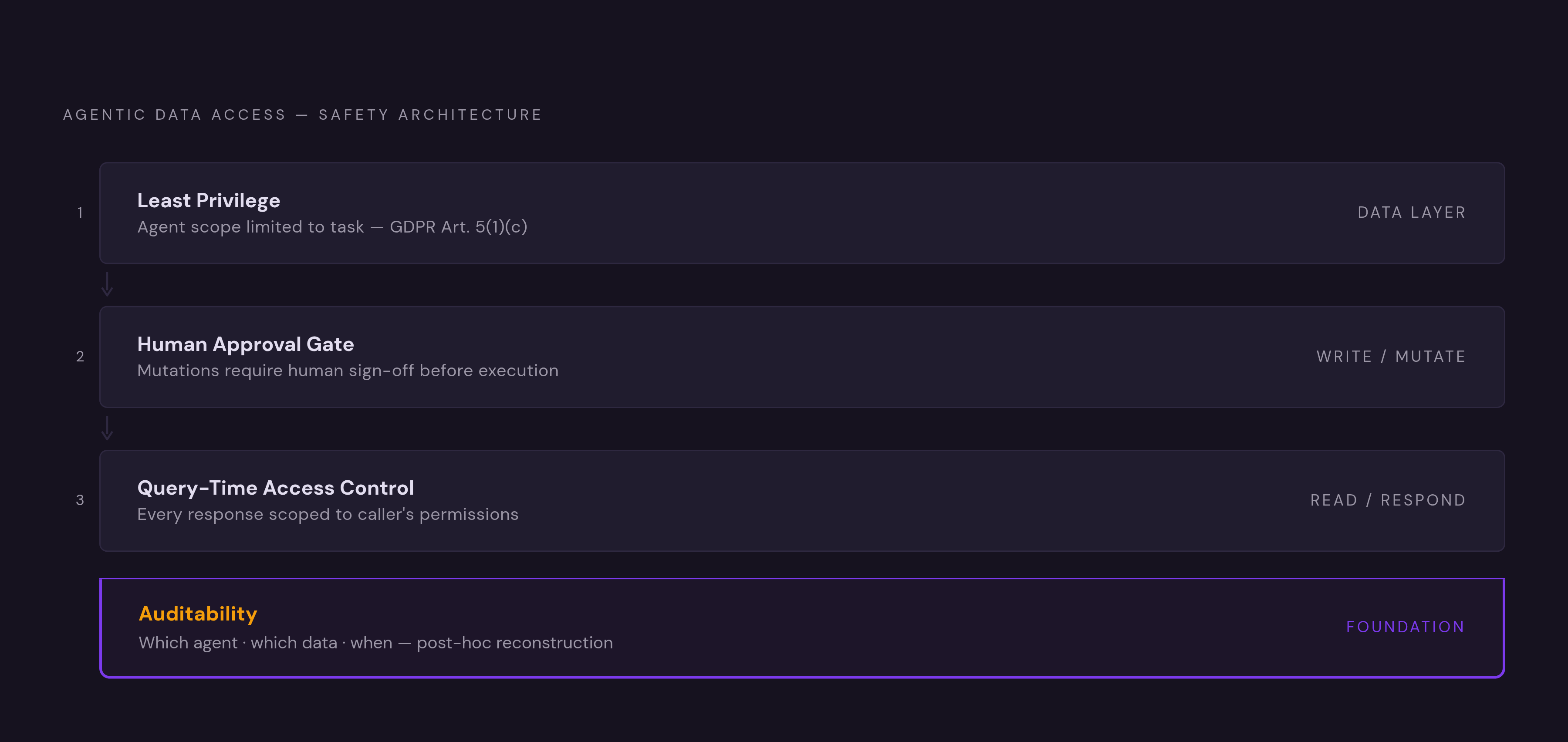
Safe agentic data access rests on three principles, and each one has to be built into the architecture itself rather than followed as a convention a team hopes everyone remembers.
The first is least privilege at the data layer. Agents operating outside their intended scope produce side effects that are hard to predict in advance: unauthorized writes, duplicate financial transactions, and regulatory exposure the moment an agent touches HIPAA, PCI, or GDPR-governed data outside the workflow it was built for. Least privilege is a direct requirement of GDPR's data minimization principle under Article 5(1)(c), so an agent with broader access than its task requires is already out of compliance before it does anything wrong with that access.
The second is a human approval gate on any mutating action. Routine documentation generation, low-risk monitoring, and read-only investigation can reasonably run without a person checking each step. Anything that mutates production, schema changes, data deletions, permission grants, writes to regulated data, needs a human in the loop before it executes. The Replit incident and the financial-loop failures that have circulated as cautionary examples are what happens when that gate gets skipped: autonomous actions that couldn't be undone because no one was positioned to stop them before they ran.
The third principle is access control enforced at the moment of the query, not assumed from wherever the data happens to sit. Every response gets scoped to what the caller is actually entitled to see, so an agent never receives more than its permissions allow, and what it does receive carries ownership and certification signals that let it distinguish a trusted dataset from one that shouldn't be relied on.
A fourth requirement underwrites all three: auditability. A clear record of who, or what agent, accessed which data becomes far more important once the actor making the request is autonomous, because without that record there's no way to reconstruct what an agent did or why it did it after the fact. The operational implication follows directly from the structural argument made throughout this piece: agents need to be governed the way organizations already govern people, with scoped credentials, defined access, and a trail that can be checked later. An agent is a credentialed actor whose access should be sized to its task, exactly like anyone else's.
Dreambase's governed datasets as a data factory for Supabase teams and their agents
Dreambase is a working implementation of the governed-dataset architecture described throughout this piece, built specifically for teams running on Supabase and Postgres. Agents querying through Dreambase never touch the production database directly. They query pre-modeled Parquet datasets served through DuckDB, accessed through a single MCP server that enforces least privilege, query-time scoping, and certification on every request.
The choice of Parquet and DuckDB as the query layer is a direct application of the format argument made earlier: columnar files allow fast scans and cheap queries, and because the metrics agents receive are pre-calculated rather than assembled from raw rows at request time, the responses are both smaller to transmit and cheaper to run inference against. One MCP server handles the entire surface area, dropping into Claude, Claude Code, ChatGPT, Codex, Cursor, Gemini, Grok, and Slack without separate integration work for each tool. A team doesn't have to rebuild its governance setup every time it adopts a new agent platform.
None of this requires an ETL pipeline, a schema migration, or a new warehouse sitting alongside Postgres. As an AI-native analytics platform built for Supabase and Postgres teams, Dreambase extends a Supabase project into full analytics capability while treating Postgres as the home for the data rather than a source to be drained into something else, consistent with its position as Supabase's featured analytics partner. The same governed datasets that answer an agent's query also drive scheduled delivery of KPIs to inbox, Slack, and an iOS app, so the number a founder reads over coffee and the number an agent cites in a board report pull from the identical pre-calculated fact. That closes the metric definition problem described earlier in a structural way rather than a procedural one: there is no second version of the number for an agent to find, because the governed dataset is the only version that exists. A founder or operator without a dedicated data team can still get board-ready dashboards and reports, built with an analyst agent working from those same governed datasets, which is the practical payoff of treating governance as infrastructure rather than as a habit someone has to remember to maintain.