Write-Then-Query Analytics Architecture for Agents That Never Open a Browser
Agents need pre-calculated metrics through API, not live database access, to stay fast and governed.
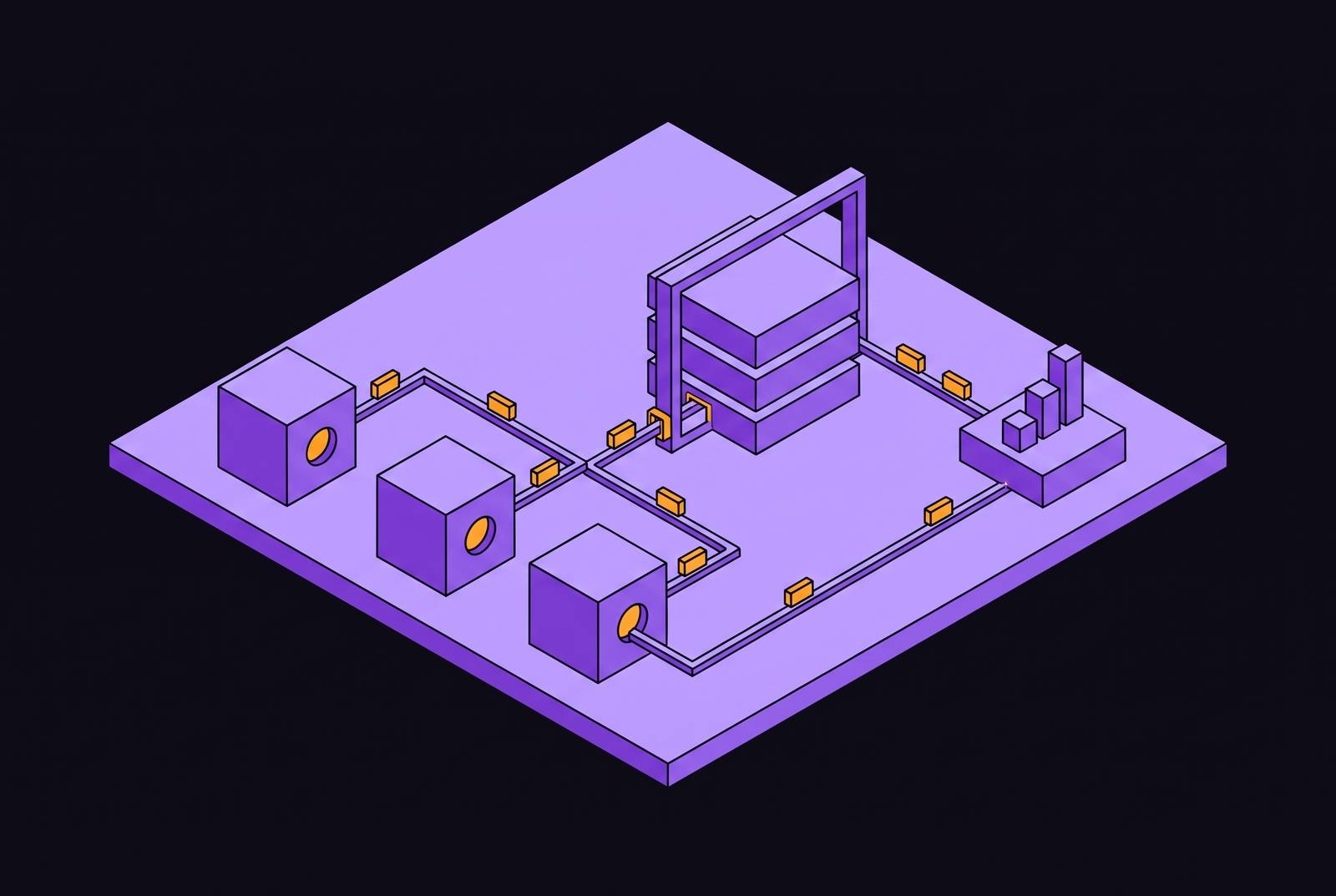
A headless analytics backend for API-first and agent-first teams should serve pre-modeled, governed datasets through MCP or API, without requiring a browser, a dashboard, or a production database connection. Write-then-query analytics architecture does this by getting trusted metrics ready before agents ask for them. Its central principle is that agents should consume agreed answers from an analytical copy, rather than interpret live production tables on demand.
Why agents querying production databases is the wrong starting point
A production database serves transactional workloads, but an agent introduces unpredictable analytical demand. Large queries compete with application traffic, and requests that come again and again can use up the connection pool. Read-only credentials prevent writes, leaving that operational risk in place along with the need to establish metric definitions and stop an agent from reading the wrong table with complete confidence. A better model cannot repair those architectural omissions.
Access control introduces a separate failure path. Production queries can bypass row-level security unless the agent’s credentials are scoped correctly, and every new agent or tool adds another access path to govern. Application-level checks become inconsistent when each interface implements its own rules. Meanwhile, an agent encountering two revenue columns cannot rely on the informal knowledge a human analyst gets from a colleague. It can choose one and act, turning an unresolved definition into a financial or operational decision.
What write-then-query architecture actually means
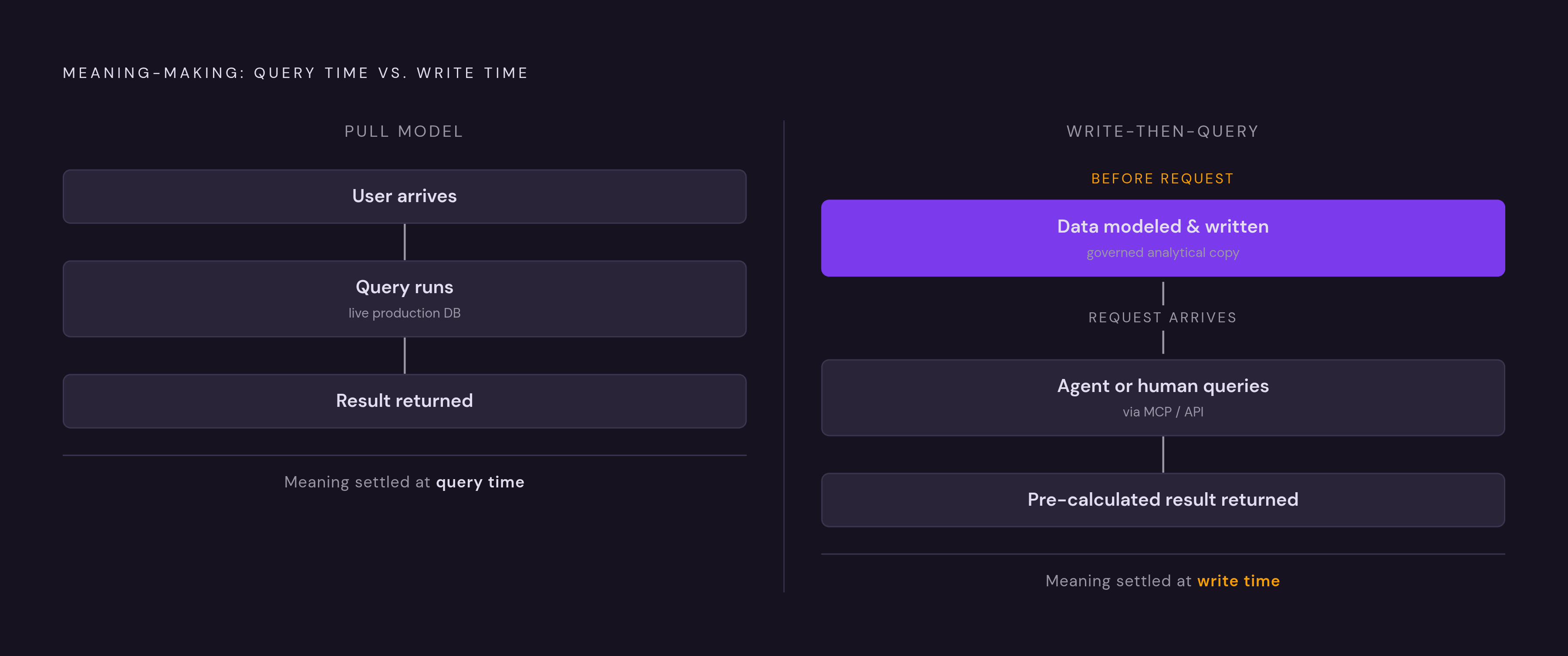
The traditional pull model begins when someone wants an answer. A user arrives, a query runs, and a result returns. Applied to agents, this makes every request another potentially unpredictable query against a live system. The meaning of the requested number may also be settled at query time, through whichever tables and calculations the consumer chooses.
Write-then-query moves that preparation ahead of the request. Data is modeled and written into a governed analytical copy that agents query, keeping their queries off production. The unit of consumption becomes a pre-calculated dataset. Humans and agents read the same prepared artifact, without independently reconstructing its meaning from raw records. This does not require an ETL migration or a separate warehouse that centralizes everything, because the analytical copy can live close to the source and be served through MCP or API.
Why agents have four data requirements that the write-first model is designed to satisfy
Agents need freshness because they keep running and act as conditions change. An inventory decision cannot safely depend on data that is hours old. A stale analytical copy fails for the same reason as a stale warehouse: its data is too old to act on safely. Write-first architecture makes freshness a responsibility of the write layer, where updates must be managed before an agent consumes the resulting dataset.
Agents also need queryability through an interface that stays the same and works as expected. An MCP tool or API gives them a defined way to request data without an ad hoc SQL connection. Predictability is part of the consumption contract. For example, an agent requesting a governed metric should not have to invent a new production query whenever it needs the same answer. The interface provides a repeatable route to the prepared dataset.
Richness supplies the business context that an interface alone cannot provide. An agent needs an explicit definition of “active customer” to avoid inferring its meaning from a column name. That context must be in place before the request comes in. Encoding agreed business definitions into the dataset is agent grounding, which gives the agent a basis for interpreting the result. Without it, successful retrieval can still produce an incorrect decision.
An agent needs discoverability to find that grounded data at all. A dataset needs a defined schema and ownership metadata. Access alone does not tell an agent where to look. COMMENT ON SQL provides a mechanism for making data discoverable through descriptive context. Together, these requirements explain why a database credential is an inadequate substitute for an agent-ready data interface.
The three layers every write-then-query architecture requires
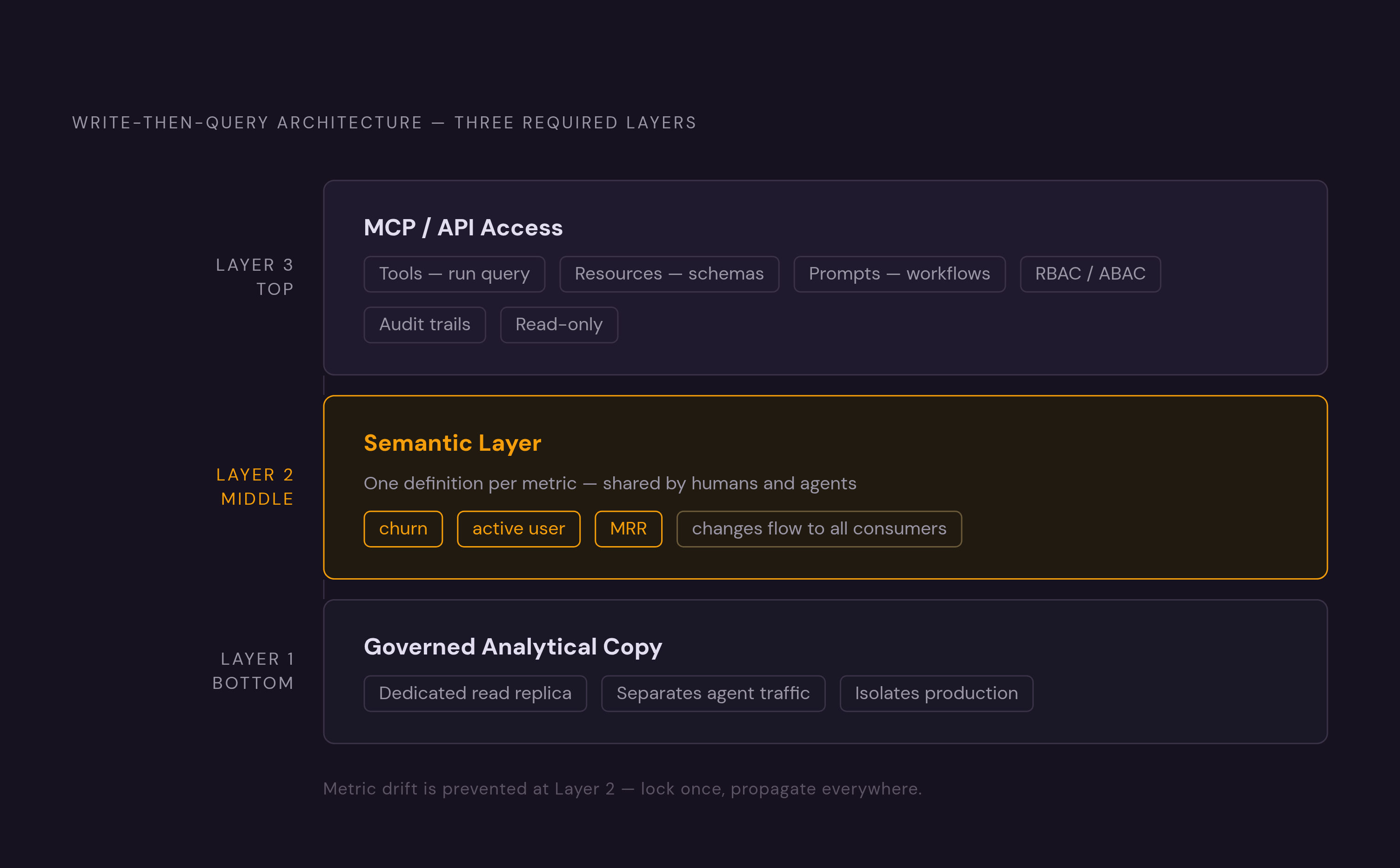
The first layer is the governed analytical copy. It separates agent query traffic from production so that analytical demand does not consume the transactional instance’s connection pool. A dedicated read replica is the recommended production pattern because large analytical queries can otherwise compete with application workloads. Isolation establishes the first boundary of the architecture. It also keeps the agent’s access path away from production rows, so protection does not depend on correctly scoped production credentials alone.
The second layer establishes what the data means. A semantic layer locks in the calculations that humans have agreed on for metrics such as churn, active user, and MRR, and stores each definition once. Faster querying cannot reconcile three definitions of conversion. A strict data dictionary gives every metric one source and every term an agreed definition, preventing metric drift across departments. When the calculation changes once in the unified semantic layer, that change flows to both human and agent consumers.
The third layer exposes those datasets through MCP or API. MCP provides client-server communication through three primitives, namely Tools for actions such as running a query, Resources for context such as schemas and governed datasets, and Prompts for reusable analytical workflows. The protocol standardizes access. MCP’s maintainers finalized a stateless revision on July 28, 2026, making horizontal scaling behind a plain load balancer possible without session-affinity constraints. That allows the access layer to grow with agent traffic, but governance must still be implemented within it.
The U.S. National Security Agency stated in May 2026 that “MCP's rapid proliferation has outpaced the development of its security model.” This makes read-only enforcement, RBAC/ABAC, and audit trails requirements that the governed access layer must implement. Credential handling must also be explicit. MCP’s confused deputy risk in proxy servers and its prohibition on token passthrough require implementations to specify what credentials go where. A single MCP server exposing governed Parquet datasets bounds the blast radius of a misconfigured query to those datasets, keeping production rows out of its reach.
What the governance layer must enforce and why application-level controls can't do it
Agents chain operations, combine sources, and change what they do based on the results they get along the way. Static rules cannot cover every access pattern that comes out of this. If each application or agent implements its own checks, every new interface becomes another place where enforcement can diverge. Governance must therefore follow the data operation rather than depend on the particular application initiating it.
The database becomes the security perimeter because users, applications, analytics tools, and agents all ask the data platform to carry out operations. Policies must work the same way across those paths and take context into account, since the same agent may need different permissions for different tasks. Enforcement cannot stop at the application boundary. The governed access layer must apply its controls where datasets are served, without leaving an alternative route that bypasses them. Audit trails belong at that same boundary.
Write-then-query adds a structural restriction to these policy checks. An agent can consume only the data that has been explicitly modeled and exposed through its governed access path. It never touches the protected production rows directly. This limits what the analytical copy’s governance must expose. The distinction is between controlling an agent’s use of a live database and giving it a bounded set of authorized analytical datasets.
How metrics fit into the write-first model — and why pre-calculation is not just a performance choice
Two engineers can produce different Q2 revenue figures by independently writing SUM(revenue) and SUM(amount_captured). The discrepancy may remain unnoticed until an investor requests audited numbers. Pre-calculating a metric makes the agreed definition concrete before either a dashboard or an agent asks for it. The resulting dataset is a semantic commitment.
For early-stage teams, MRR, CAC, LTV, churn rate, and cash runway describe revenue growth, acquisition efficiency, retention, and available runway. Their usefulness depends on definitions that hold across departments. When sales, finance, and product maintain their own versions of ARR, executives’ debate over the numbers displaces discussion of the choices those numbers should inform. Every metric on the CEO dashboard should reconcile to a single source.
An agent querying pre-calculated MRR receives the same number the CFO sees because both consume the same artifact. An agent querying raw billing rows has no equivalent guarantee, however capable its SQL generation may be. Metrics should be pushed to the inbox, Slack, or phone rather than depend on someone remembering to open a dashboard. Pre-calculation supports that push model by preparing one governed result for delivery wherever people work.
How do Supabase teams add agent analytics with raw API access and no prebuilt dashboard?
Supabase is an open-source BaaS built on PostgreSQL, bundling PostgREST, Realtime, Auth, Storage, Edge Functions, and connection pooling. That gives startups SQL, APIs, authentication, and realtime capabilities from one control plane. Analytical isolation remains a separate architectural concern. Connection limits, poor indexing, chatty queries such as N+1 patterns, misuse of realtime subscriptions, and insufficient compute can all constrain scaling. Adding agent traffic to an already constrained connection pool accelerates the problem.
For a Supabase team, the write-first pattern keeps production Postgres transactional. A data layer works against a read replica or through CDC to write pre-calculated metrics as Parquet, queryable through DuckDB. This pattern works without a separate warehouse, ETL migration, schema changes, or new infrastructure on the production instance. The governed analytical layer sits between the source and every human or agent consuming its metrics.
A single MCP server can then expose the governed datasets to agents. The agent calls a tool, receives a pre-modeled answer, and never holds a Postgres connection. An API provides another programmatic consumption path. Human dashboards can use those same datasets in a headless analytics backend that separates analytical preparation and governance from the interface that presents or acts on the result, allowing use independent of an opinionated frontend or dashboard login.
The backend needs analytical isolation, shared metric definitions, governed MCP or API access, and audit trails. A browser-based interface is not the architectural requirement. Early founders and growing teams can get that discipline through a partner model without hiring a dedicated data engineer. The value of that model is replacing the work of operating a data layer, rather than adding another system whose definitions and permissions the team must reconcile.
The infrastructure gap that most Supabase teams hit before they see the agent problem coming
Before agents enter the system, slow queries, disputed numbers, and the absence of a single source of truth have usually appeared. Agents make the existing weaknesses harder to ignore. Good schema design, targeted indexes, query analysis, and connection management offer a stronger starting point than adding compute blindly. The recommended first step is to move expensive reporting workloads to replicas or materialized views.
Observability makes that separation possible before a production incident forces it. Slow query monitoring and connection count alerting show pressure that might stay hidden until agents start making requests. An active connection count approaching max_connections is a danger signal. Teams that instrument their Supabase instance from day one and separate analytical workloads are better positioned to add agents without an infrastructure crisis. Without those foundations, an agent query storm can coincide with a production incident.
Problems with data access and trust can stall agent projects before production, however capable the model is. For startups without a dedicated data team, recovering from that stall is especially difficult. Putting the analytical copy and metric definitions in place before the first AI workflow lets agent access build on the architecture that is already there. Retrofitting governance after agents are running is the expensive path.