Governed Data Access When MCP Becomes the Query Interface for Autonomous Agents
Agents querying through MCP need enforced policy and audit trails.
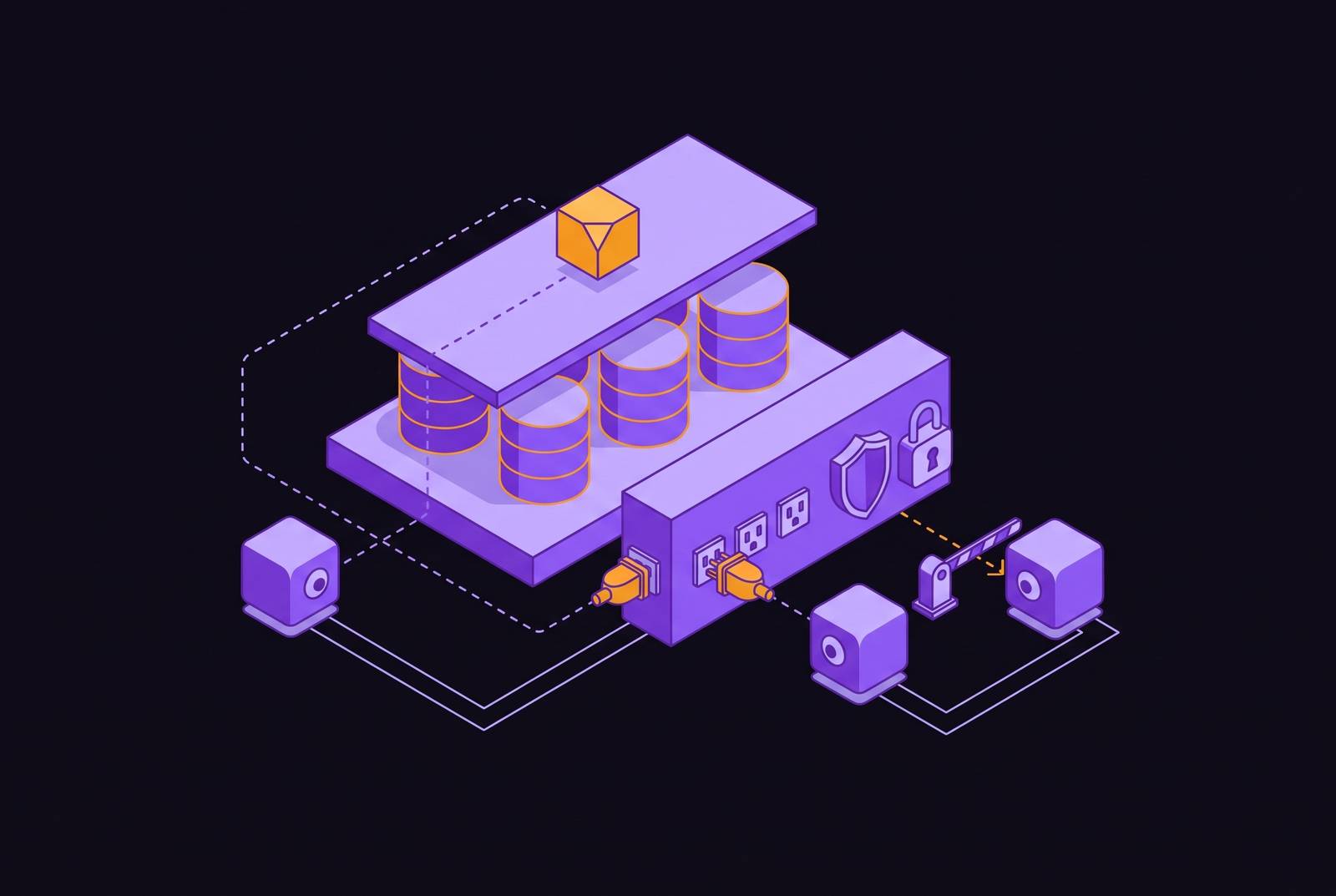
For API-first and agent-first teams, the headless analytics pattern separates governed datasets and metric definitions from any opinionated frontend. When MCP becomes an autonomous agent’s query interface, that backend must enforce access policy and shared business definitions and have the infrastructure collect audit records, as well as expose tables. For Supabase teams, the architectural choice is a governed layer between agents and data.
How MCP turned data access into an autonomous act
Before MCP, connecting N AI models to M data sources required N×M custom integrations, each with its own authentication logic and risk of drift. MCP replaces that matrix with N+M implementations, because each client and each source implements the same protocol. The integration boundary changes as a result. A source no longer needs a bespoke connector for every model that might use it, and a compatible client can reach a compatible server without another integration.
The mechanics are deliberately small relative to that change. MCP defines a Host–Client–Server architecture over JSON-RPC 2.0, with three primitives, namely Tools for actions, Resources for data, and Prompts for templates. Anthropic announced MCP on November 25, 2024, and donated it to the Agentic AI Foundation under the Linux Foundation in December 2025. Anthropic, Block, and OpenAI co-founded the foundation. ChatGPT, Cursor, Gemini, Microsoft Copilot, and Visual Studio Code all integrate MCP natively, making the interface relevant across model providers’ environments and platforms.
The more consequential change concerns who decides to query. In a traditional human-directed API workflow, a person determines the request or establishes the sequence that produces it. An autonomous agent instead decides which tools to invoke, what data to fetch, and how to chain operations without waiting for approval at each step. The connector is no longer the whole story. Data access becomes part of how the agent reasons, and the machine makes those decisions faster than a periodic review can check them.
Why MCP was built for connectivity and not for governance
MCP standardizes communication without defining the organization’s access policy. It is neutral about what a server exposes, so compatibility does not establish whether an agent should receive a particular dataset or perform a particular action. MCP enables connectivity, while the server and surrounding infrastructure must supply the controls that make a connection appropriate.
MCP supports bidirectional communication, server-pushed updates, and stateful, long-lived connections with metadata about capabilities and permissions, creating a persistent trust relationship. Authenticating the client, authorizing a request, validating inputs, and logging the result remain useful, but a single initial authorization cannot settle every decision made during an evolving task.
Tool discovery makes that distinction especially important. The MCP-Zero paper shows agents asking for tools mid-task as they learn more about the problem. The available access surface is therefore not necessarily fixed when the workflow is designed. A policy boundary must remain meaningful even when the agent discovers a capability that was not part of its initial plan.
The July 28, 2026 protocol revision and updated first-tier SDKs did not add native role-based access control. Protocol evolution therefore did not remove the need for a separate governance architecture. Configuration can narrow an individual server’s exposure, but it cannot supply shared metric definitions or infrastructure-wide policy by itself. Without controls set up for this purpose, an agent can access whatever the server exposes and the agent requests.
Three attack surfaces that emerge specifically because agents are autonomous
Context injection takes advantage of the boundary between the information an agent reads and the instructions it follows. When data context can influence the agent as though it were an instruction, a retrieval operation can redirect subsequent decisions. The agent then acts on that interpretation autonomously. Strict architectural separation of “System Instructions” from “Data Context” is the required defense, although model providers are still working to solve this boundary problem. Ordinary input validation does not settle whether a model will treat retrieved content as authority.
Privilege escalation through tool chaining exploits a different boundary. An agent begins with legitimate access to one tool, then uses that access to discover and invoke adjacent tools it was not explicitly granted. A compromised integration can expose a wider toolchain because the agent reasons across the capabilities it can use, going beyond a single unauthorized API call. Authorization must therefore constrain the entire chain, including its starting point.
Standing privilege extends exposure across the life of a session. Agents maintain persistent MCP connections, so broadly scoped, long-lived credentials leave a wide blast radius for a compromise or logic error. The initial handshake is not enough protection. The Coalition for Secure AI recommends Zero Standing Privilege principles, including credentials that are short-lived and task-scoped, and agent identities whose baseline permissions differ from those of the users or systems they represent.
Context leakage can make these three attack surfaces more dangerous. Agents keep information about earlier interactions, the capabilities they can use, and the data in the current task. If that state reaches an unintended tool or an insecure log, sensitive information can escape through context sharing without a direct database request. Controls must cover the context an agent keeps as well as the tables it can query, because a result can flow elsewhere as the agent continues to reason.
What a governed data layer between agent and source actually requires
The architectural response is one governed access interface through which every agent reaches data, regardless of the model behind it. This creates a chokepoint for consistent policy evaluation and logging rather than a separate security implementation for each connector. Identity must remain meaningful throughout the interaction. Cryptographic proof of identity, continuous authentication, and attribute-based access control allow decisions to reflect both the agent’s identity at login and its current security posture. Row-level security limits visible records, while column-level masking redacts sensitive fields within otherwise permitted queries.
Agents also need business-friendly abstractions over pre-modeled datasets, with restrictions on access to production tables. The definition must precede the agent’s interpretation. Otherwise, an agent can invent business logic even when its query is authorized, while a logic error or prompt injection can reach production directly. The recommended boundary excludes direct agent write access to production databases.
Auditability supplies a separate requirement. Infrastructure must record which agent invoked which tool, what data it requested, what policy was evaluated, and what outcome followed. These records must not depend on the agent’s own account of its behavior. Agent-reported provenance is not a tamper-proof audit trail. Structured transcripts collected by the infrastructure make policy enforcement inspectable independently of the reasoning system being governed.
Four layers organize these responsibilities into an architecture. The Data Substrate supplies verified, permissioned, refreshable data with documented provenance. The Reasoning Layer supplies semantic schemas, governed context, and metric definitions, which the Delivery Layer exposes through an MCP endpoint. The Decision Layer connects action to an owner and an outcome. Each layer has a distinct job, so a working endpoint cannot substitute for trusted data or defined business meaning.
Block used a version of this pattern with a data mesh approach, a governed semantic layer, and custom MCP servers for AI-powered analytics. Its key separation was between semantic definitions and the query surface. Agents got governed metrics, with no need to build definitions from raw tables. That separation also removed a review bottleneck. Because the definitions were already trusted, the governed layer removed the SQL review step, showing that governance can make work easier as well as add approval gates.
Why Supabase projects face this governance problem acutely when MCP is added
Supabase’s official MCP server exposes a powerful operational interface, including mutating operations unless teams configure it otherwise. Without read_only=true, a connected agent can execute SQL, apply migrations, deploy Edge Functions, and mutate project resources. Read-only access is a deliberate configuration choice. Enabling it runs queries through a read-only PostgreSQL user and removes mutating tools from the permitted surface, substantially changing what autonomous tool selection can reach.
Supabase also added a Row Level Security advisory through PR #251 on April 20, 2026, and released it in v0.8.0 on April 30. When RLS is disabled on a table, the server injects a warning with per-table remediation SQL, documentation links, and messaging about exposure risks. The warning makes an important gap visible. It does not, by itself, create the semantic definitions, continuous policy evaluation, or audit architecture required by a governed data layer.
Even a read-only agent can produce unreliable analytics. One engineer may define revenue as SUM(revenue), while another uses SUM(amount_captured), so Q2 revenue depends on which query runs. An agent querying the same tables adds another interpreter. Unlike an analyst who might ask for clarification, it can resolve ambiguity silently by constructing SQL and returning a confident answer. Repeated inconsistencies then erode trust in dashboards without requiring a security incident.
For B2B SaaS teams, the affected definitions include CAC, LTV, monthly churn, ARR, and gross margin. Companies at an earlier stage may rely more on activation, retention, and learning signals. These numbers shape decisions on funding, who to hire, and which product bets to make. Teams should therefore establish a small set of actionable KPIs appropriate to the company’s stage, with owners and SLAs, before agents are connected to them. A shared, modeled, pre-calculated dataset gives humans and agents the same fixed, machine-readable definition.
Supabase’s observability hooks address a different need. Live Postgres statistics expose bloat, cache hit rate, locks, and slow queries through the CLI, Explorer, or MCP execute_sql. Log queries can run against ClickHouse events. The Metrics API exposes database metrics compatible with a monitoring system. That instrumentation helps teams inspect database behavior. It does not determine what revenue means, which records an agent should receive, or whether a requested action is permitted.
What MCP as a governance seam looks like in practice for a Supabase-based team
For a Supabase-based team, the governed architecture reverses the default query path. Instead of exposing production Postgres, the agent’s MCP server exposes pre-calculated metrics and governed Parquet datasets that have already been modeled, permissioned, and versioned. Production is outside the analytical query path. DuckDB can query those pre-modeled datasets quickly and cheaply, without schema changes, ETL, or a separate data warehouse between the team and its numbers.
This gives the four-layer model a concrete implementation. The governed datasets are the Data Substrate, and the metric definitions they share are the Reasoning Layer. MCP supplies the Delivery Layer rather than becoming the place where business meaning is improvised. The Decision Layer remains tied to an owner and an outcome. Every agent reaches the same definitions, row-level permissions, and audit trail through shared infrastructure, regardless of its model or orchestration framework.
For buyers asking how to add analytics to an AI agent without a prebuilt dashboard, this is the headless analytics pattern. Analytics logic is decoupled from the frontend, and governed datasets are exposed to the consumers that need them. The interface does not dictate the presentation. A founder’s dashboard, a Slack bot’s weekly summary, an autonomous growth agent, and an API endpoint can use the same definitions without teams having to rebuild governance for each one. The relevant criteria are API control, semantic consistency, permission enforcement, and an independent audit trail.
Informatica announced fully headless data management through native MCP support at Informatica World 2026 in Las Vegas, with announcements on May 20. Its MCP endpoints expose metadata search, data quality checks, address validation, and MDM operations. That is a broader data-management use case.
For a Supabase founder without a dedicated data team, the practical recommendation is to establish the governed layer before autonomous access scales. Starting with a small, owned set of decision-driving metrics keeps the semantic work focused. That scope can grow with the business. The alternative is to define the boundary after metric inconsistency or an agent-induced production incident has already forced the question.
Sources
- MCP-Zero: Active Tool Discovery for Autonomous LLM Agents
- What Is MCP (Model Context Protocol)? Complete Guide 2026
- Streamlined policy administration of model context protocol servers for artificial intelligence agents
- ScaleMCP: Dynamic and Auto-Synchronizing Model Context Protocol Tools for LLM Agents