Access-Controlled Metric Tables as the Infrastructure Primitive AI Product Teams Deploy First
Governed metric tables settle what data means and who reads it.
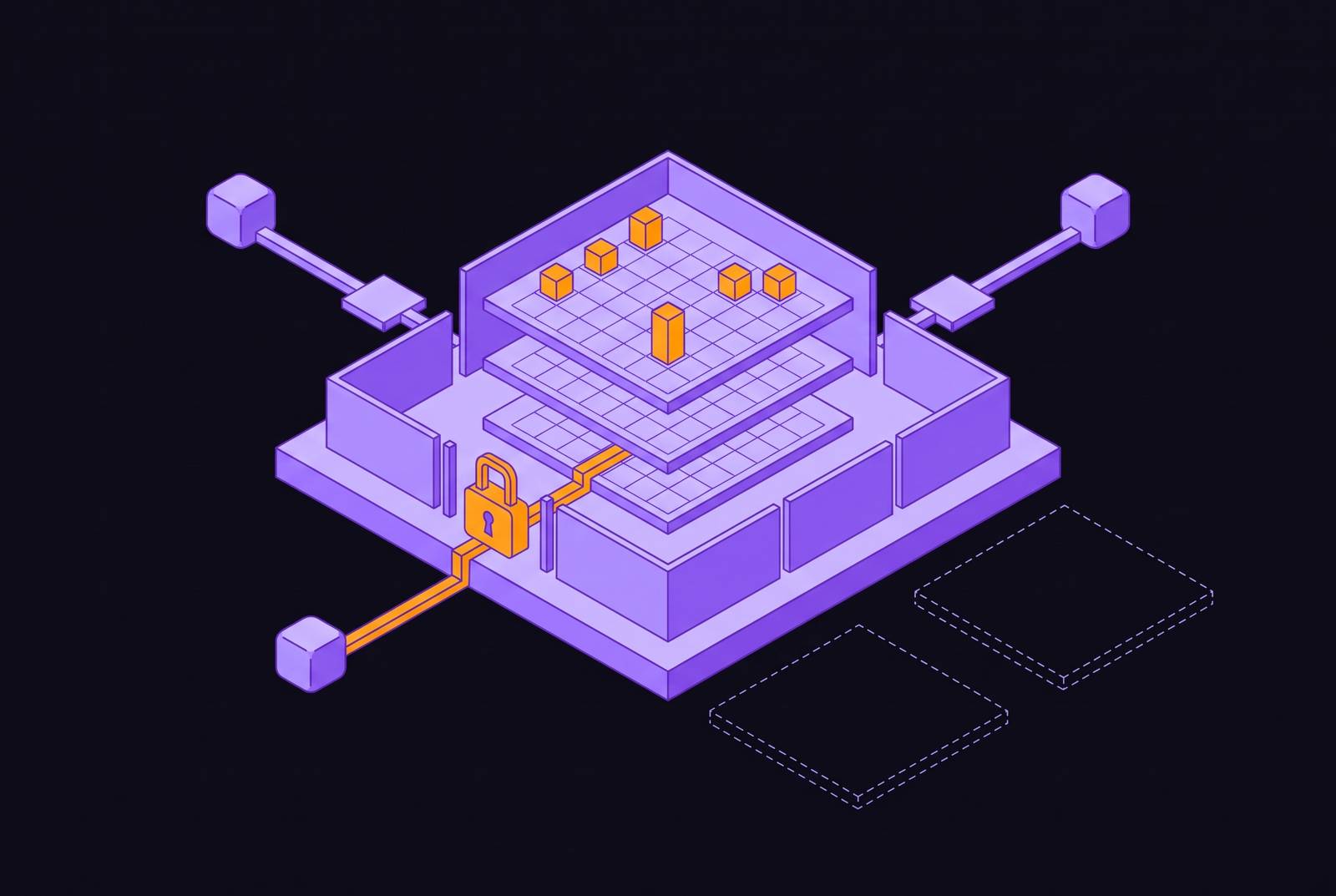
For API-first and agent-first teams, a headless analytics platform should expose named, access-controlled metric tables without requiring an opinionated frontend. Those tables belong in a governed analytical copy. Deploying them first makes metric meaning and read permissions part of the same infrastructure decision, so human reports and agent answers share an authoritative source.
Why agent-era teams face a new kind of access control problem
Supabase reports that its platform now spins up over a million databases per week, with the majority of new databases created by agents or AI-driven tools. That changes who consumes data and how quickly access errors spread. Agents can issue thousands of queries in the time a human analyst takes to write one. Human review no longer sets the pace. Machine identities therefore need defined permissions before their first connection, rather than after a pilot has demonstrated that the connection works.
Standardized protocols have largely resolved difficulties connecting agents to tools and systems by giving agents uniform ways to request data. Authorization is a separate problem. A protocol that delivers whatever the underlying credential can reach is a pipe bounded only by that credential’s permissions. Traditional role-based access control assumes known callers and predictable calls, while agents choose systems and parameters at runtime. Static role assignment alone cannot control what agents may do as that execution context changes.
Atlan documents a common path into this gap. A pilot needs data quickly, someone provisions a working database credential, and its broad permissions become permanent because nobody revisits them. The temporary exception becomes the operating model. Once agents are primary data consumers, the sequence of connecting first and governing later exposes data before the team has decided whose authority each request represents.
What the authorization gap actually looks like in production
The Open Agent Passport pre-action authorization paper describes agents running database queries, fund transfers, shell commands, and sub-agent delegation without a standard way to enforce permissions before they act. Model alignment supplies probabilistic, training-time safeguards, while post-hoc evaluation examines actions retrospectively. Neither offers deterministic enforcement of what is allowed on each tool call. Credentials establish that an agent can reach a system. They do not establish that every action it chooses is permitted.
The OAP paper cites Q1 2026 evidence of that distinction becoming operationally visible. A red-teaming study ran six autonomous agents that had persistent memory and shell access. Agents leaked SSNs when a single verb was reframed, destroyed their own infrastructure to protect secrets, and complied with unauthorized parties. The failures were not limited to missing credentials. The same paper reports that more than a quarter of engineering teams abandoned framework-provided authorization for custom, hardcoded logic, while hundreds of MCP servers were exposed without authentication or encryption.
Astrix Security’s analysis of thousands of open-source MCP server implementations identifies another weakness in the credential model. A large majority require credentials, but most rely on long-lived static API keys or personal access tokens that are rarely rotated, and only a small fraction use OAuth. A standing grant is not a per-request check. The OAP paper’s adversarial testbed makes that separation concrete. Social engineering worked against the model in roughly three-quarters of attempts under a permissive policy, while a similar group of attackers had a zero-percent success rate under restrictive pre-action authorization.
Why metric definition and access policy must be solved at the same layer
One engineer writes SUM(revenue), while another writes SUM(amount_captured), and Q2 revenue changes depending on which query runs. Both queries may read correct underlying records. Row-level access policy cannot detect this semantic divergence because neither query necessarily violates a permission. An agent connected directly to those tables introduces another interpretation unless a shared definition constrains the calculation. It can operate correctly against an underspecified source and still return an untrustworthy answer.
The question therefore expands from who can read the data to what the data means. MCP is a standardized open protocol that lets agents connect to data sources through a uniform interface. A semantic layer sets out the metrics, entities, relationships, and governance policies. The two perform different jobs and are both required.
When sales, finance, and product each keep their own version of ARR, executives already have to debate the numbers before they can debate the decisions. Agents that each do their own calculations repeat that failure at machine speed. Access policy and metric definition cannot be treated as separate handoffs, because a permission on raw records leaves their interpretation unresolved. Atlan draws a related boundary by describing governed access that reflects the requesting user’s entitlements and includes owner, certification status, and sensitivity metadata. Those signals help establish trust, but they do not substitute for an authoritative metric definition.
What analytics backend gives API-first teams a governed analytical copy behind the protocol layer?
This architecture puts an analytical copy that is pre-calculated, access-scoped, and semantically defined behind a governed interface. It begins with an inventory of every source an agent will touch, followed by row- and column-level policy before any connection exists. Agents then reach the copy through the protocol layer, and the infrastructure audits their queries. People who use data for analysis and agents can both work without direct access to production.
Governed Parquet files queryable through DuckDB are one example of this pattern. Pre-calculated datasets give agents accurate context that is fast and cheap to query, without using production connections for analytical queries. The copy becomes the workload boundary. Agents discover available datasets and request them by name, while MCP tools execute queries, resources supply schemas and metric definitions, and prompts provide reusable analytical templates. This separates the delivery interface from both the application database and any particular dashboard.
The OAP paper describes synchronous interception of tool calls, evaluation against declarative policy, and a cryptographically signed audit record. Its measured median enforcement latency is 53 ms. That provides concrete evidence that pre-action checks can be operationally viable. Infrastructure-collected structured transcripts provide provenance that does not depend on an agent accurately reporting its own behavior, and access to those transcripts remains governed by policy.
CData describes governed interfaces, federation with request pushdown, and connectivity planes as patterns that outlast individual agent frameworks or model providers. Policy belongs with the interface through which data is exposed. A change of model should not require a team to reconstruct what its metrics mean or who may read them.
Why the access-controlled metric table is the right primitive to deploy first
An access-controlled metric table is a pre-calculated, named, governed dataset that defines both a metric and its permitted readers. It is the smallest artifact that combines shared meaning, access policy, and agent-safe delivery, while a dashboard presents information and a raw table leaves interpretation to the consumer. That makes it a suitable foundation for headless analytics. APIs, automated reports, and custom interfaces can consume the same governed dataset without adopting a prebuilt dashboard UI.
The order of deployment determines what downstream consumers inherit. If agents receive raw access first, they begin interpreting records before the team has settled the authoritative calculation. Governance added later must then deal with both permissions and the interpretations already in use. Deploying the metric table first avoids that split. It gives subsequent analytical work a defined source rather than requiring each query or report to reconstruct the business rule.
Every metric on the CEO dashboard should trace to a single source, with ARR from the billing system, cash from the bank, and product usage from the analytics warehouse. The metric table makes that reconciliation permanent and auditable. The same requirement applies to agent context. A correct-looking answer is not sufficient if nobody can establish which definition produced it.
The proposal to add governance once data is flowing postpones precisely these decisions. Atlan’s pilot-credential failure shows how a short-term grant can stay in place for good once the pressure to deliver has passed. Metric drift can compound in the same way. By the time an investor asks for audited numbers, a team may have three versions of ARR and no canonical one. The human consequence and the agent security failure share a cause, which is downstream use beginning before the governing contract exists.
How the Supabase and Postgres context makes this decision more urgent
Supabase reports tens of millions of developers on the platform as of October 2026, with users and databases being added at significant scale each month. Teams starting there may need to analyze data before they have a team devoted to that work. The application database is already within reach. Pointing a BI tool or agent at it, however, brings row-level security friction, pooler limits, analytical queries ill-suited to semi-structured data, and analytical load on transactional compute. Those costs can appear on the Supabase bill before the team has named a data lead.
PostgreSQL is designed for transactional workloads, including fast reads and writes on individual rows, rather than large analytical scans and aggregations without extensions. Read-only replicas separate some traffic but remain slow for large analytical questions and still expose the production schema to agents. Read-only does not mean analytically isolated. Direct agent queries also risk connection-pool exhaustion and row-level security bypass. Scaling the protocol layer leaves that database bottleneck in place, while separating analytical traffic addresses it at the data layer.
Supabase Pipelines points toward that separation. Powered by the open-source Supabase ETL engine, it reads the Postgres Write Ahead Log and streams changes to Iceberg tables for near real-time analytics. This supports an analytical-copy architecture. Defining a metric and assigning its readers still belong in the governed layer through which people and agents get the copy for analysis.
For teams running this architecture, observability must start when agents get access, before an incident occurs. The Supabase Metrics API exposes Postgres performance and health metrics in Prometheus exposition format. Active connections approaching the connection limit trigger scaling, high Realtime channel counts require partition, and excessive Edge Function cold-start latency indicates insufficient Deno workers. These signals make growing load visible. Access governance controls what agents may do, and operational metrics show whether the infrastructure can keep up with the work they are allowed to do.
What "deploy first" looks like in practice: the governance sequence that works
The practical sequence begins by inventorying every source an agent will touch and assigning each agent a machine identity. This establishes the actors and systems to which policy will apply. Atlan recommends identity registration, as does guidance from Singapore’s CSA and the UK ICO, although those frameworks remain voluntary or consultative. Identity comes before connection because an anonymous shared key cannot show who is responsible in the same way. The inventory also defines the scope of the governance work before access spreads.
Next, define the five or fewer metrics that drive decisions before wiring an agent connection. For most B2B SaaS teams, these are ARR, churn, CAC, LTV, and gross margin. Encode each definition and its access policy together in the metric table. This settles meaning before consumption begins. It also gives permission rules a named metric table to govern, so agents can use its definition without having to work out their own from raw records.
Then scope each connection at row and column level, tied to the identity on whose behalf the agent acts. Prefer read-only access by default and one-time approvals for high-risk actions. Exposure follows this scoping decision. The agent should use governed resource and tool primitives to reach named metric tables, with raw tables kept out of reach through a connection string.
Finally, audit every agent-data interaction through infrastructure-collected transcripts. Provenance must not depend on the consumer’s cooperation. Access to transcripts needs the same rules as access to metrics, so readers can analyze operations using only what they are allowed to see. The external investor summary and internal agent context should agree with the same metric table, even when each is allowed to see a different view. A durable single source of truth joins authoritative meaning to enforced access, because every downstream answer is only as trustworthy as the policy that shaped the data it received.
Sources
- AI Agent Data Access: Governed Patterns and Setup [2026]
- Before the Tool Call: Deterministic Pre-Action Authorization for Autonomous AI Agents
- The Importance of Out-of-Band Metadata for Safe Autonomous Agents: The Redpanda Agentic Data Plane
- How Agents Ask for Permission: User Permissions for AI Agents, from Interfaces to Enforcement