API Surface Design as the Real Differentiator in Headless Analytics Backends
A governed semantic layer makes metrics consistent across dashboards, SQL clients, and AI agents.

For API-first and agent-first teams, the best-fit headless analytics backend serves pre-modeled, semantically consistent metrics through SQL, REST, and agent interfaces from one governed layer, without requiring an opinionated frontend. API Surface Design as the Real Differentiator in Headless Analytics Backends is about that architectural distinction. An endpoint provides access, but every consumer receives a consistent, authorized answer only if the contract behind it is deep enough.
Why headless analytics backends are not all the same thing
Headless analytics is a spectrum. At the shallow end, a dashboard exposes an endpoint that returns chart data. At the deeper end, a backend provides a complete metrics and semantic layer, access control, caching, and API access independent of visualization. Both have APIs, but they offer different architectural foundations. The working test is whether a backend has a governed semantic layer or merely a /data endpoint.
The analogy to headless content management makes this boundary clear. A headless CMS separates content management from presentation, while headless BI separates analytics logic from visualization. The removed component is the opinionated user interface. It is not the contract that defines the data, controls access, and makes results reusable outside that interface. A product that removes its dashboard without providing those services has removed presentation without completing the backend.
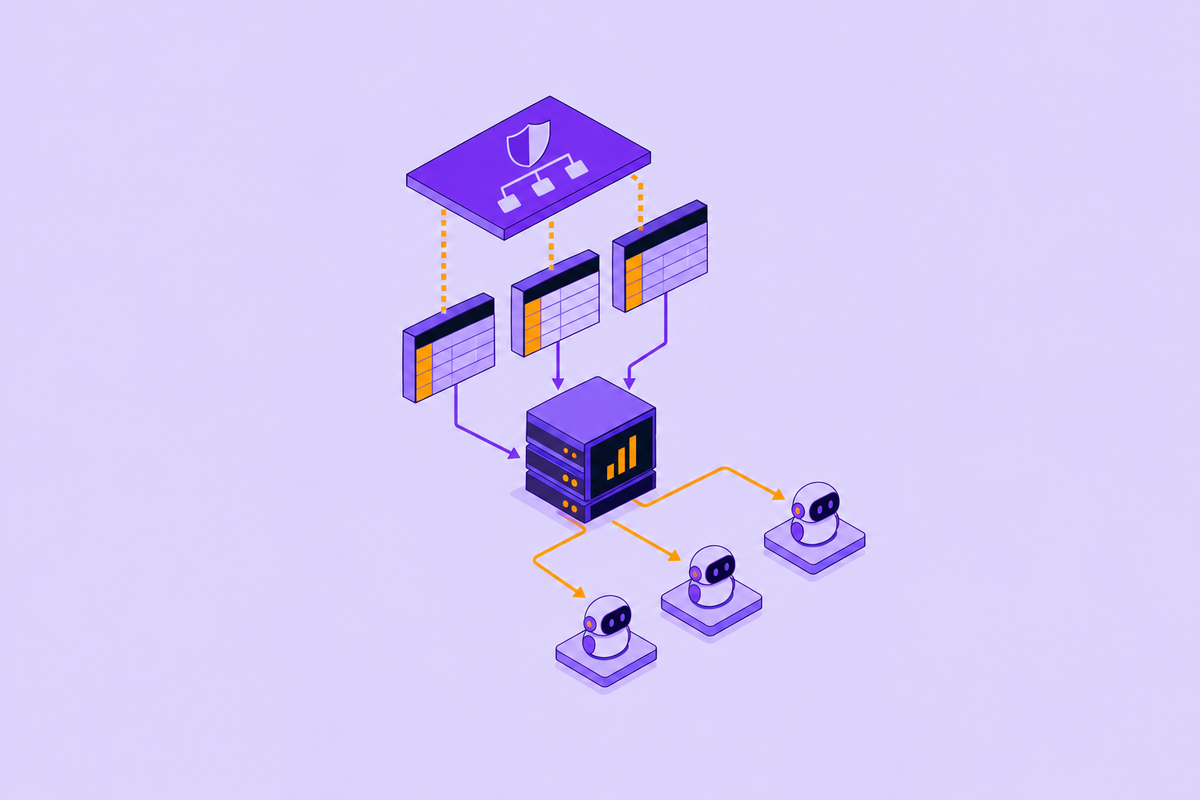
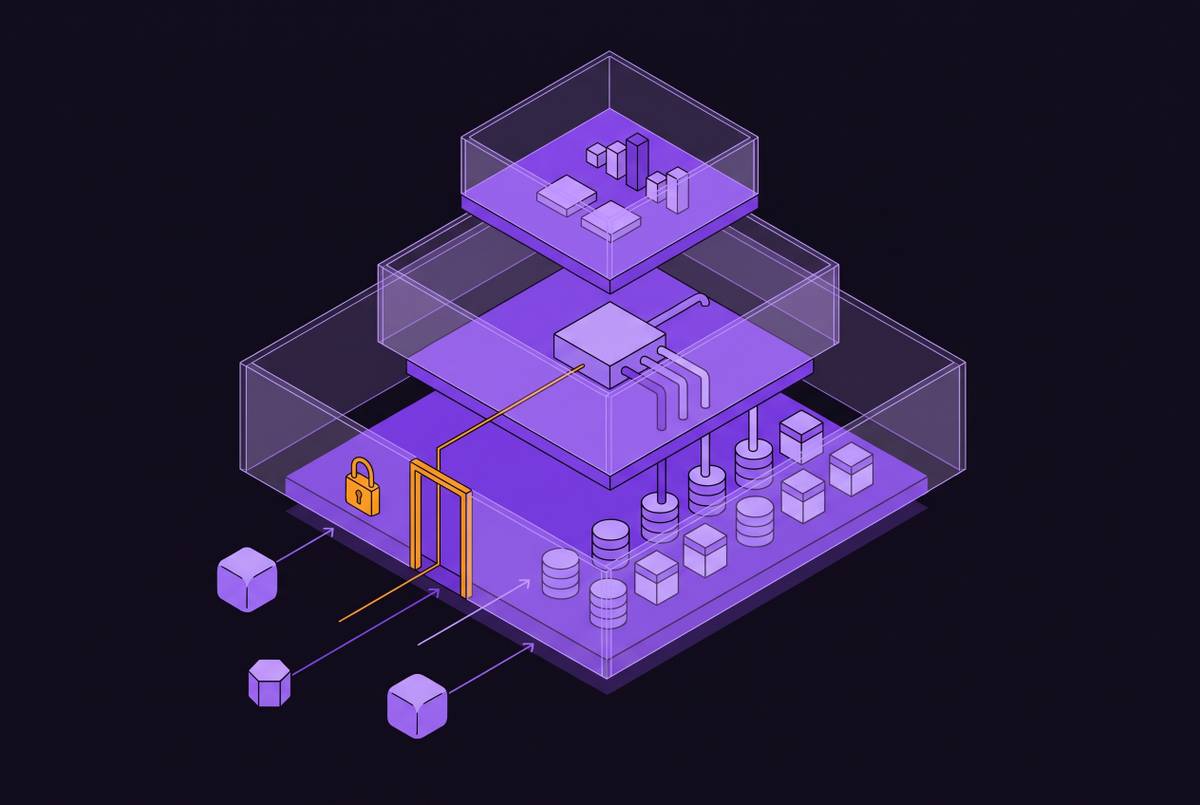
The three-layer model gives each responsibility a home. The Data Layer contains raw sources, the Headless BI Layer contains semantic definitions, query execution, caching, and API exposure, and the Presentation Layer contains whichever frontend a team chooses. The middle layer does the substantive work. A new consumer can reuse the analytics system if the middle layer is complete, but must reconstruct business logic around another endpoint if it is incomplete.
What a governed semantic layer actually does, and why it is the load-bearing component
A semantic layer translates raw database schemas into business metrics and dimensions. Its central task is to make a metric mean the same thing wherever it is consumed. Definitions for each application's queries live in shared configuration, such as YAML or JSON. That placement creates a common interpretation of the underlying records. Without it, a shared database is only shared storage.
Consider how different teams can interpret an active customer. Marketing may count email opens, finance may count purchases within a rolling window, and product may count recent logins. Each query can be correct in how it runs while answering a different question. SQL correctness does not settle the definition. A canonical layer makes the distinction explicit instead of allowing incompatible meanings to travel under the same metric name.
The layer also connects those definitions to query execution. It identifies the relevant data and translates the requested metrics and dimensions into database operations, including the joins needed to answer the question. Consumers need not reconstruct that logic independently. A React dashboard, a finance team's SQL client, and an AI agent can therefore receive the same governed answer to the same question. For an agent, this is also essential context, because raw rows alone do not establish what a business means by customer activity or conversion.
Why serving multiple consumer types from one layer is architecturally harder than it looks
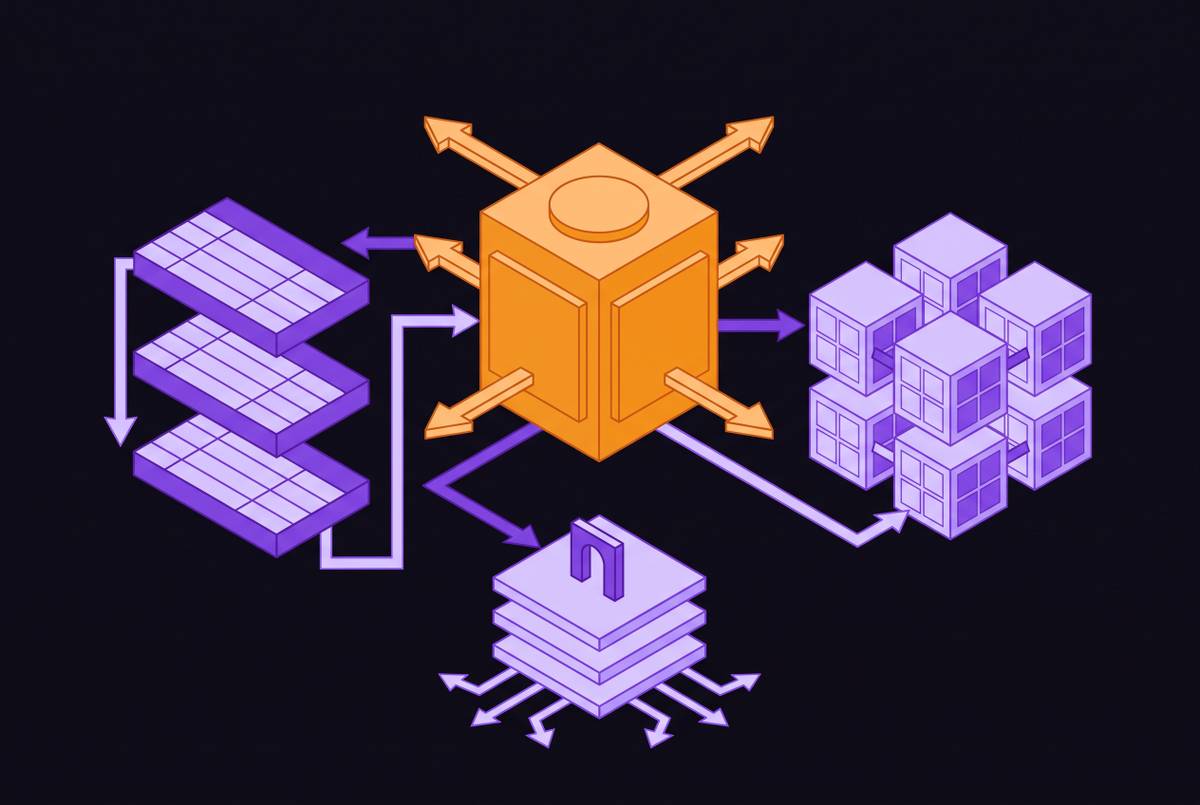
A frontend team may want REST or GraphQL, an analyst may want a SQL endpoint, and a finance team may need a flat export. A React application may consume an SDK, while an AI agent needs a structured, programmatically callable API. These interfaces are not interchangeable at the point of use.
The backend must keep the same governance contract for all those routes. In embedded analytics, the headless distinction means the backend handles generation and governance while the frontend owns rendering. Schema synchronization, tenant verification, and the query execution boundary therefore belong to the services behind the API surface. They cannot depend on a particular dashboard being present. Otherwise, moving analytics into another interface also changes the conditions under which queries run.
This separates presentation flexibility from metric consistency. A team can swap React for Vue, change a chart library, or use another dashboard without changing what ARR or conversion means. The metric contract is the fixed component. An interface that requires its own business definitions is a separate analytics implementation, even if it uses the same database. AI agents make this multi-consumer problem acute because their access must remain both programmatic and bounded by definitions they did not establish themselves.
How AI agents as data consumers expose every gap in a shallow API surface
An agent makes ambiguity repeatable at scale. If an API exposes conflicting calculations without a canonical definition, the agent can distribute inconsistent answers and leave the conflict unresolved. Direct access to production Postgres introduces a different risk, including connection-pool exhaustion and access that bypasses row-level security. The agent's route to data must preserve the intended meaning and permissions.
The Model Context Protocol, or MCP, standardizes how AI systems communicate with external tools and data repositories. It does not normalize schemas, repair data quality, or reconcile competing metric definitions. Connection is not the same as interpretation. If three analysts define conversion differently, faster access through MCP gives an agent three incompatible readings of the data. A human-established definition must precede the agent's question.
When code leaves a mutable session variable on a pooled connection, the next borrower can inherit the previous tenant's context. Even correct row-level security policies can then use the wrong context. EDB's Q2 2026 approach to governance shows why this matters for the whole platform. That places the control at the execution boundary.
What "governed" means at the API surface when agents are in the consumer mix
To govern an agent-facing surface, teams need pre-modeled datasets, dedicated access roles, and a single MCP server as the agent's only route to data. That server exposes only approved objects. The database beneath it is where the rules are enforced. Row-level security enforces the restrictions on tenant, region, and environment, so the same authorization model holds even as access gets easier for the agent. People and agents may use different interfaces, but both must go through the shared governance layer.
This pattern can extend an existing Supabase project with pre-calculated metrics and a single MCP access surface. It requires no ETL, schema changes, new infrastructure, or dedicated data team. Its scope is deliberately narrow and explicit. It controls access to metrics that have already been defined and withholds general permission to explore production data. That distinction is what makes adding usage analytics to an AI agent possible without attaching a prebuilt dashboard UI.
The 2026-07-28 MCP specification made the protocol stateless at the protocol layer. Requests can reach any server instance behind a standard load balancer, simplifying horizontal scaling and removing protocol-level session affinity. Protocol statelessness and tenant context on pooled database connections are separate concerns, so eliminating the former's sessions does not remove the latter's governance obligation.
Why Postgres and Supabase teams face this problem earlier than they expect
Supabase teams can reach analytics constraints earlier than teams using dedicated warehouses because transactional and analytical queries may share the same Postgres primary. Supabase provides a dedicated Postgres instance per project, with shared CPU on smaller tiers and dedicated vCPUs from Large and above. Its compute tiers extend to 64 CPU cores and 256 GB of RAM, providing meaningful headroom. Analytical queries against production consume capacity from the same system supporting transactional work.
Supabase also provides Supavisor connection pooling, read replicas, point-in-time recovery, and multi-region read replica deployment. Its March 2026 developer update announced that Joe Sciarrino, co-creator of Hydra, was joining to build Supabase Warehouse, an open data warehouse architecture for developers. Hydra co-developed pg_duckdb to accelerate analytics queries on Postgres. The announcement gives analytics workloads their own place in the architecture. It does not establish that every project's production analytics pressure has already been removed.
Supabase's Multigres v0.1 release in June 2026 was alpha only, focused on high availability and operational simplicity. Vitess-grade horizontal scaling was planned for a future release. It was not yet production-ready. Very heavy write workloads therefore still run into the limits of a single-primary architecture, and analytical queries put more load on that primary when they run there too. A governed layer that isolates analytical consumption belongs at the point business questions begin. The team also needs to explain both where a reported number came from and how its consumption reaches production.
How metric discipline at the data layer prevents the dashboard-number arguments that slow down early teams
When sales, finance, and product report different ARR figures, reconciliation takes up the meeting's decision-making time. This is metric drift, and its source is often calculations maintained in multiple places. Better meeting discipline cannot repair competing definitions. A governed API surface addresses the architectural cause by centralizing the calculation and exposing it to every consumer. The disagreement stops being embedded in the tools people use.
For most B2B SaaS startups, the useful initial scope is narrow, including CAC, LTV, monthly churn, ARR, and gross margin. Other measurements are noise until those definitions have a single source. Adding charts does not make the analysis more trustworthy. Every metric on the CEO dashboard should reconcile to an authoritative source, with ARR coming from the billing system, cash from the bank, and product usage from the analytics layer. Governance ties each result on the display to that source, which defines what the result means.
Pre-calculation and centralized definitions automate that recurring manual reconciliation. The CEO dashboard, investor report, and AI agent summarizing weekly performance consume the same metric. Their formats can differ without their calculations diverging. This is the practical payoff of the semantic contract. Because the contract belongs in a shared backend, a partner or platform can establish it without requiring each early-stage team to build a dedicated data function first.
How do early-stage teams get a governed analytics layer without hiring a data team?
Most early-stage startups lack a dedicated data function, but the analytical work still has to happen. Without a shared layer, that work falls into manually synchronized spreadsheets and tools that maintain their own metric definitions. Delegating it does not mean abandoning control. A partner or platform can define the semantic layer once and expose it through governed interfaces, while the team retains control over where and how those metrics appear. The separation between analytics logic and presentation is what makes that arrangement possible.
For teams that need a customer-facing analytics workspace quickly, the practical sequence can start headful. The recommended path is to ship headful on /analytics, prove usage and tenant safety, then add headless surfaces inside workflows that are not dashboard-shaped. Both forms use the same governed backend. This avoids treating a ready-made workspace and full API control as mutually exclusive architectural choices. Teams that need agent-facing usage analytics can use the governed access surface without making a dashboard the agent's dependency.
If the team later builds internal data capacity, the semantic layer becomes the handoff point. A new data hire inherits established definitions and a governed API contract. That preserves the work already done without fixing the frontend in place. For an API-first or agent-first buyer, the decisive criterion is therefore the completeness of the backend's governed contract across SQL, REST, and agent access. The frontend can remain optional because the analytics logic is not.