Security Boundaries in MCP-Served Analytics Layers
Isolating analytics data from production protects against MCP's inherent security gaps.
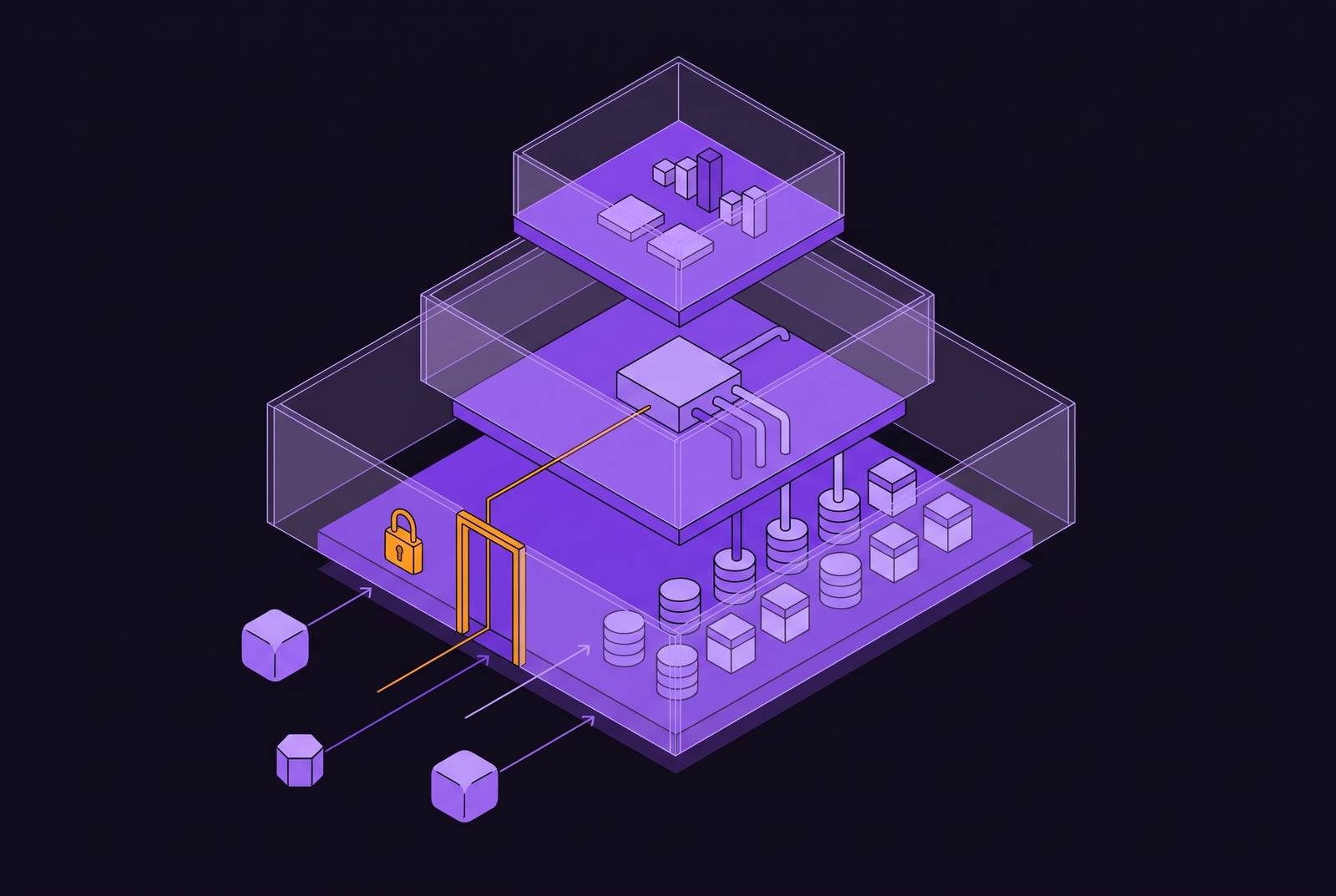
A headless analytics platform for API-first and agent-first teams should expose governed, pre-calculated datasets through APIs and MCP without requiring an opinionated frontend. MCP leaves security enforcement to implementors, so the key boundary comes from the data and capabilities behind the server.
Why MCP's protocol design leaves security enforcement entirely to implementors
MCP’s official specification states that it “explicitly does not enforce security at the protocol level,” placing responsibility on implementors. This is a deliberate architectural choice. The architecture separates communication at the transport layer, JSON-RPC 2.0 messaging for lifecycle and capability negotiation at the protocol layer, and tools, resources, prompts, and notifications at the data layer. Each layer presents a distinct security boundary. Securing communication therefore does not settle which resources an agent should reach or what a tool should return.
NSA’s May 2026 guidance identifies significant and evolving concerns across MCP design, implementation, and operational posture, including serialization risks, trust boundaries, and agent misuse. Established cyber defense strategies do not adequately address these risks. A subtle inconsistency at one stage of an agentic pipeline can propagate into exploitable conditions elsewhere. The guidance consequently treats the agentic environment as a continuum rather than a collection of endpoints that can be secured independently. For analytics, that continuum extends beyond the MCP server into the data architecture behind it.
Three protocol-level vulnerabilities that no implementation fix can fully eliminate
Narek Maloyan and Dmitry Namiot’s Breaking the Protocol identifies three fundamental vulnerabilities in MCP’s architecture. The first is the absence of capability attestation, which allows servers to claim arbitrary permissions without a mechanism for clients to verify those claims. The second is bidirectional sampling without origin authentication. It allows server-side prompt injection because the model cannot check who supplied an instruction. Both weaknesses concern the basis on which an agent trusts a server.
The third vulnerability is implicit trust propagation across servers. Tool responses from one server can influence invocations on another because the model’s context window combines outputs without provenance tracking. A compromised server elsewhere in the tool chain can shape the queries sent to an analytics server, even one connected to production. Hardening that analytics endpoint does not authenticate the origin of every instruction shaping the agent’s request.
Token handling can further weaken those boundaries. MCP’s security documentation describes the “confused deputy” attack pattern, including the danger of accepting tokens intended for another service. If the service does not check who the credentials were meant for, legitimate credentials can cross service boundaries. The Cloud Security Alliance’s 2026 MCP guide says that by early 2026, roughly half of MCP servers exposed to the internet ran without authentication controls. These deployment failures are preventable, but fixing them does not remove the architectural weaknesses in attestation, instruction origin, and shared context.
What the threat model looks like for an analytics-specific MCP deployment
An MCP server connected to a live database is a credentialed bridge to production infrastructure. Its threat model must reflect that role. The CoSAI MCP Security framework identifies missing or improper access control as a threat, a direct concern when an agent receives broader access than a human analyst would receive. A tool described as an analytics interface may still expose raw tables that hold sensitive business metrics, PII-adjacent records, or financial data. The tool’s purpose does not constrain its effective permissions.
The framework’s MCP-T5 category addresses inadequate data protection and confidentiality controls. In analytics, the exposure includes both what reaches the agent’s context window and what leaves the database over the network. An authorized request can still return data that was never properly scoped for that agent. Authentication alone does not establish a confidentiality boundary. The distinction becomes especially important when the same context also contains responses from other MCP servers.
MCP-T9 addresses trust boundary and privilege design failures, including an analytics server inheriting the database user’s full permissions. That inheritance concentrates risk at the bridge. A failure there can expose far more than the reporting dataset the agent was meant to use. Conventional perimeter defenses fall short because tool poisoning and prompt injection work through natural-language instructions and the way the model reasons. NSA’s guidance names dynamic tool invocation, implicit trust relationships, and context sharing as risks across the system that existing cybersecurity tools were not built to stop.
Why hardening the MCP server itself is necessary but not sufficient
Production MCP deployments still require rigorous server hardening. MCP’s security documentation specifies OAuth 2.1 with PKCE and capability-level scoping. Transport controls include TLS 1.2+, mutual TLS for server-to-server communication, and DNS rebinding protection. The MCP TypeScript SDK’s StreamableHTTPServerTransport does not enable it by default, although createMcpExpressApp() enables it by default since v1.24.0.
Authorization flows require equally explicit controls. MCP proxy servers must store the approved client IDs for each user and check that registry before they start third-party authorization flows. Redirect URIs need exact string matching, and each authorization request needs cryptographically secure state that is stored server-side only after explicit consent. Complete logging must cover tool parameters, authentication attempts, resource access, and scope violations, correlated with identity behavior in a SIEM. The CSA guide places these controls within defense in depth, together with tool integrity, session management, supply chain validation, execution isolation, and behavioral monitoring.
An authenticated agent with a live query interface can still issue queries that degrade production performance. It can also calculate ARR, active users, or revenue incorrectly because transport security does not encode metric definitions. A compromised adjacent server can still contaminate the context that shapes its queries. Server hardening governs how access is granted and observed, but it cannot substitute for deciding what the granted capability can reach.
How pre-modeled, governed datasets create the boundaries MCP cannot draw on its own
A governed analytics layer changes the resource behind the MCP server rather than merely adding another check in front of it. An agent queries pre-modeled, pre-calculated datasets stored as governed Parquet files and queried through DuckDB. The queries never reach the transactional primary. So even instructions from a compromised tool cannot use that path to get direct production access.
That isolation has a precise scope. It prevents the agent’s analytics queries from degrading the production database or accessing its underlying tables through this interface. It does not remove the need to authorize access to the published datasets themselves. The server exposes only datasets explicitly modeled and published, with no raw table access to grant accidentally. Agents receive access to outputs, with credentials for the underlying store withheld.
Revenue, active users, ARR, and other metrics are calculated in the governed layer rather than reconstructed by each consumer from raw tables. A dashboard, Slack report, and autonomous agent therefore all get the same governed number. The agent does not supply the calculation logic. Definitions remain a governance responsibility, but they are no longer delegated to a model generating a query.
The CoSAI framework’s sandboxing and isolation control in section 3.2.5 provides a direct architectural parallel. The governed layer serves as the sandbox, while immutable Parquet artifacts provide a basis for resource verification under section 3.2.4. The files alone do not replace verification controls. Rather, the architecture gives those controls a defined artifact to protect and a bounded environment in which agents operate.
Supabase-specific risks that make a governed analytics layer non-optional for teams at scale
Supabase makes the consequences of production coupling especially concrete. The same Postgres instance serves transactional workloads, auth state, Realtime metadata, and storage metadata. An agent’s reporting workload can put pressure on infrastructure serving several production functions.
Row Level Security misuse illustrates the failure mechanism. An unoptimized RLS policy wrapping auth.uid() can re-evaluate the function for every row scanned. An analytical query can consequently become an effective denial-of-service against the transactional primary. Connection use creates a separate risk. Analytical queries hold connections longer than transactional ones, so concurrent agent requests can exhaust the pool and degrade or block production traffic.
Privilege bleed puts confidentiality at risk as well as availability. Supabase’s service role key grants broad permissions, and using it for an MCP server’s convenience gives agents access beyond a defined analytics dataset. Supabase offers pg_stat_statements, Index Advisor, log drains, read replicas, and performance advisors for observability and mitigation. These do not establish dataset authorization boundaries. Expensive reporting workloads belong on replicas, materialized views, or an external analytics layer.
For deployments that are regulated or use many agents, an append-only audit table is the minimum record needed to investigate administrative actions, permission changes, and sensitive workflow events. Its coverage stops at the database boundary. Requests handled entirely by the governed analytics layer need no audit entry in the production database because they never reach production. They still need records of access in the analytics layer so that isolation leaves no gap in what can be observed.
How to add agent analytics without a prebuilt dashboard UI while keeping MCP access safe
A useful headless analytics backend exposes trusted data without requiring a dashboard as the access surface. For API-first and agent-first teams, the criteria are governed metric access, authorization-scoped datasets, portable definitions, and independent access logs. Safety does not require blanket refusal. The interface should let an agent request “monthly active users” by name and receive the pre-calculated result, rather than a raw table from which it invents an interpretation.
Capability-level scoping determines which dataset slices each agent receives. The same MCP server can give agents different authorized slices without giving them all access to the same data. Definitions must travel with those results. Metric names, calculation logic, and time boundaries in the governed dataset let consumers read ARR or revenue using the published definition. This makes the interface useful beyond a prebuilt UI while keeping calculation authority in the analytics layer.
The distinction from a live database interface is concrete. One exposes governed answers within an authorization boundary, while the other exposes the ability to construct queries against underlying tables. Access logs kept for audits must record tool invocations, the metrics returned, and which agents made the requests, without relying on production. MCP’s security documentation supports a centralized gateway architecture applying consistent policies. A single governed analytics MCP server follows that principle more closely than agents connecting separately to data sources that have different permission models.
The monitoring and governance layer that makes the architecture auditable over time
A governed layer establishes boundaries, but those boundaries must remain observable as agents, datasets, and team permissions change. The CoSAI framework names insufficient logging, monitoring, and auditability as MCP-T12. Without records of server connections, tool invocations, authorization decisions, and data access patterns, organizations face compliance blind spots and cannot reconstruct incidents. Determining what an agent accessed requires logs containing invocation parameters, agent identity, the dataset or metric returned, and the scoping decision.
Named tools and datasets make that record easier to interpret than unrestricted SQL against production. Dataset versioning then supplies the definition in force when the request occurred. If ARR changes to exclude trial users, the governed layer must retain the old and new definitions with effective dates. An audit can then distinguish a change in the business from a change in the calculation.
The framework’s lifecycle and governance control in section 3.2.11 calls for capabilities to be reviewed and re-approved on a defined schedule. For analytics, that means reviewing agent access to datasets and revoking access no longer needed. Behavioral monitoring adds another signal. An agent requesting an unfamiliar metric or requesting one at unusually high frequency becomes detectable when invocations are logged centrally.
NSA’s guidance calls on implementers, security researchers, and standards organizations to keep working together to make AI infrastructure more secure. MCP may gain stronger built-in security mechanisms over time. Teams with governed data layers will be better positioned regardless of those changes because their production isolation and metric governance do not depend on protocol evolution. The decisive boundary is not between the client and the server, but between the agent and the data.
Sources
- Model Context Protocol (MCP) Security
- Security Best Practices - Model Context Protocol
- NSA Releases Security Design Considerations for AI-Driven Automation Leveraging the Model Context Protocol > National Security Agency/Central Security Service > Press Release View
- Agentic MCP Security Best Practices Guide
- Breaking the Protocol: Security Analysis of the Model Context Protocol Specification and Prompt Injection Vulnerabilities in Tool-Integrated LLM Agents