Promotion Boundaries That Make Governed Metrics the Terminal Query Surface for AI Agents on Supabase
Agents query a governed analytical copy, never production Postgres.

To give AI agents governed access to Supabase via MCP without exposing production tables, place pre-modeled metrics in a separate analytical copy behind the MCP server. A promotion boundary makes that copy the terminal query surface, where agent queries end, keeping production Postgres outside their query path. This setup keeps application resources, metric definitions, and agent permissions separate, so prompts or production access rules do not have to keep them in line.
Why AI agents querying production Postgres directly is an architectural problem, not a policy one
When an agent fires its first query, production Postgres has no inherent way to distinguish that request from application traffic using the same connection path. Both consume resources on the same instance. Agents issue queries at machine speed rather than human speed, so connection-pool exhaustion can arrive before anyone notices the pressure. The application and the agent are competing for a finite pool, even when every query is permitted.
Permission leakage compounds that resource problem. A shared credential grants whatever the connection can reach, potentially exceeding what the agent’s current task requires. Even careful prompting cannot limit those privileges, and access-key rotation leaves the connection architecture as it is. Even a query that runs correctly can use up scarce capacity or use permissions that go beyond what its task needs.
Row-level security addresses only part of this exposure. RLS limits which rows a caller can see on production, but it does not prevent authorized queries from saturating the pool. Nor do production policies automatically follow data when it is copied or derived. These are separate problems of resource isolation and authorization scope, which cannot be resolved by treating direct database access as merely a policy choice.
What a promotion boundary is and what it separates
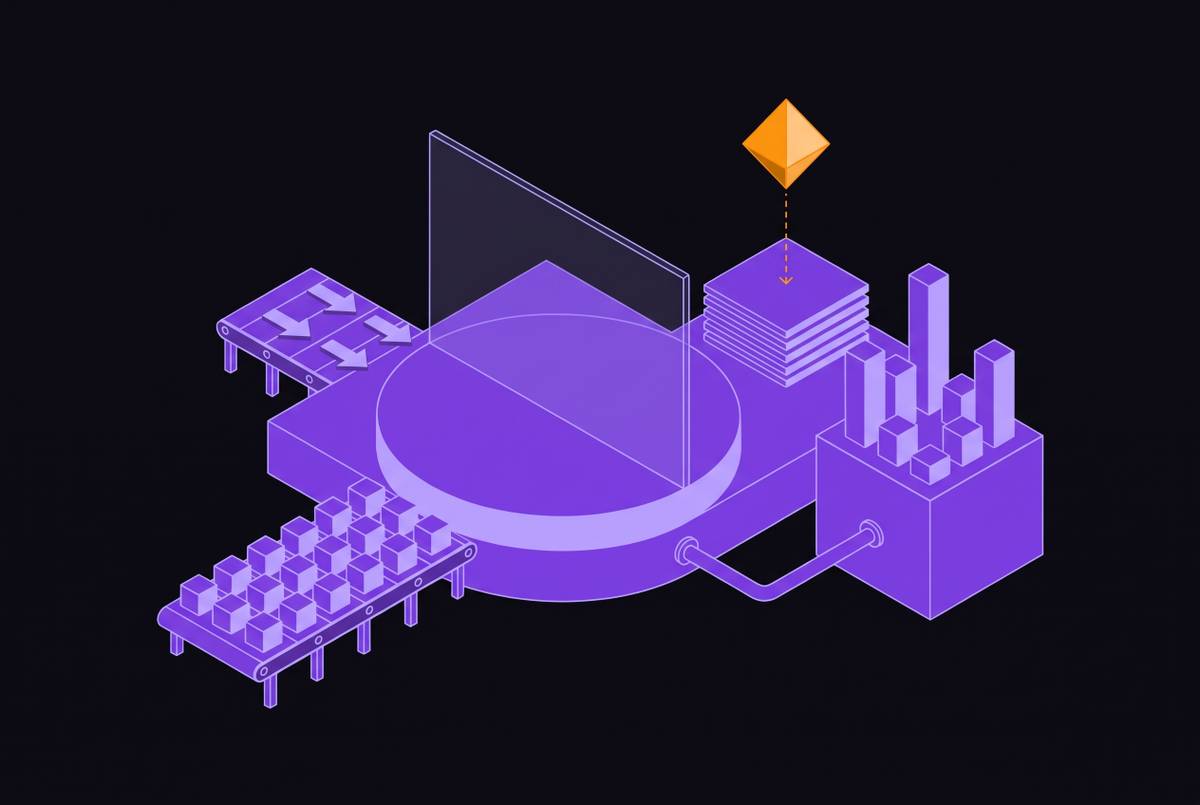
A promotion boundary separates the live production instance from the governed analytical copy that agents are permitted to query. Production serves application traffic on one side. On the other, pre-modeled metrics provide the only data surface exposed to agents. This is not another access-control rule applied to the same database, because the agent-facing surface is a different destination.
What crosses that boundary is a promoted dataset. Promotion moves a metric from its raw source into a defined, calculated, and governed form before any agent request arrives. The agent has no raw table access and cannot use application connection strings or make schema mutations. An agent can ask questions of the analytical copy, but those questions do not become ad-hoc queries against production.
The word “terminal” describes where execution stops. The analytical copy answers the request rather than forwarding it to the operational database. That distinction separates a promotion boundary from an intermediary that merely hides a production connection behind a tool name. A proxy can still expose the same underlying resources and privileges, even when its interface appears narrower.
The decisive property is the missing connection path. Data moves into the governed copy through promotion, while agent tooling has no production connection to traverse. A configured restriction depends on a rule continuing to deny access to an existing path. A structural boundary removes that path from the agent’s architecture.
Why pre-modeled, governed metrics must exist before the MCP server is involved
An MCP server cannot supply definitions that the underlying data lacks. Placing it in front of ambiguously named tables standardizes access without resolving what those tables mean. One caller can calculate SUM(revenue) while another calculates SUM(amount_captured), so they get different answers to the same business question. Both queries may execute successfully. Neither successful execution nor a controlled interface establishes which answer the organization intends.
Separate choices in billing and CRM can produce competing definitions of ARR. Governance requires a single definition for each metric, with calculations such as MRR, LTV, and ARR computed in one place and versioned. Pre-calculation then makes the analytical copy a store of answers with governed meanings. Dataset-level access rules must also exist independently, because production RLS does not migrate with the result.
MCP exposes that work through its Tools, which run queries, its Resources, which expose datasets and schemas, and its Prompts, which provide reusable analytical templates. A Resource pointing to an ungoverned table provides no semantic guarantee simply because discovery is standardized. An agent may infer a plausible definition from column names, but that inference remains probabilistic. A governed metric supplies a deterministic calculation under an explicit definition, which is a different basis for a financial or operational decision.
The OAP pre-action authorization paper says agents have passwords but no permission slips. It identifies the absence of a standard mechanism to enforce authorization before a tool call executes. Pre-modeled datasets provide a defined object against which query-time authorization can be evaluated, although the dataset itself does not replace enforcement. The dependency runs from governance to access.
How to let AI agents query Supabase data without direct database access
On Supabase, the concrete pattern places governed Parquet datasets behind an MCP server and uses DuckDB to query them. Supabase Postgres remains the source of truth for raw events and continues serving application traffic. Pre-modeled metrics are promoted into the analytical copy. DuckDB executes agent queries against those files without opening a Postgres connection or consuming a production pool slot.
Agents discover the available governed datasets by name through MCP Resources and request datasets or pre-calculated metrics through Tools. Agents querying an analytical copy in place of formulating raw SQL against production tables is the operational difference from a read-only route to production. Read-only access can constrain mutations while still sending queries to the application’s database, whereas file-based execution removes that competition from the agent query path.
Supabase’s observability instruments provide concrete inputs for governed operational datasets. The Supabase Metrics API exposes Postgres metrics in a format compatible with monitoring systems, including CPU, IO, WAL, connections, and query statistics. pg_stat_statements supplies mean and total query time and call counts as a diagnostic foundation. Active connection counts measured against max_connections reveal pressure toward the configured limit, while regressions are visible in slow query logs before users report them. These observations can go into the analytical copy, so agents have no need to check production directly.
The July 28, 2026 protocol revision finalized by MCP’s maintainers adds a separate scaling property through stateless MCP. An MCP server can scale like a REST API, without session affinity or shared protocol state, while the governed copy remains its bounded query surface. Without a promotion boundary, additional MCP server instances simply create more routes to the same exhaustible connection pool.
What agents can and cannot do at the terminal query surface
Agents can retrieve named metrics such as MRR, ARR, CAC, churn, and gross margin. They can discover dataset definitions through Resources, use pre-approved analytical templates through Prompts, and receive metadata identifying the owner, certification status, and sensitivity classification. This context gives the agent more than a number. It provides the definition and governance status needed to interpret that number.
The excluded capabilities are equally explicit. Agents cannot issue raw SQL against production tables, modify schema, or access rows outside the analytical copy’s dataset-level rules. They must not accumulate standing access beyond a specific task. For row-level access controls at this surface, the relevant criterion is enforcement on the analytical copy independently of RLS on the source database. A server that exposes copied data without those rules has not preserved the intended authorization boundary.
Identity must therefore reach the terminal surface. An on-behalf-of chain ties access to the identity for whom the agent acts, rather than treating the agent as a generic service account. That relationship makes per-task scoping possible. It also distinguishes authorization to use a tool from authorization to retrieve a particular dataset through it.
The OAP paper reports that synchronous, policy-based checks before tool execution reduced adversarial success from a majority of attempts to zero in its testbed. That finding demonstrates the value of deterministic enforcement outside model reasoning. The same infrastructure can make sure security constraints, quality gates, and operational contracts are met. At the data layer, ten deterministically correct metrics offer a more reliable basis for analysis than a thousand ambiguously defined raw columns, without implying that every conclusion an agent draws will be correct.
The regulatory and security context that makes this boundary non-negotiable
Security guidance more and more treats autonomous agents as identities whose permissions need a clear purpose and lifecycle. The Five Eyes guidance published in May 2026 warns against excessive access and applies Zero Trust and least-privilege principles to autonomous systems. A promotion boundary gives those principles a concrete data-layer form. It limits both the destination an agent can reach and the governed datasets available once it gets there.
The guidance also reflects a change in emphasis. The 2023 CISA/NCSC guidance focused on secure AI design, development, deployment, and operation across the development lifecycle. The 2026 guidance covers how agents carry out multi-step workflows with real-world consequences and how the systems as a whole hold up. The OAP paper says that 90% of government organizations have no purpose-binding controls for AI agents. That gap concerns whether an authorized identity is acting within an authorized purpose.
The UK ICO’s ongoing call for evidence on agentic AI reinforces expectations around agent identification, defined ownership, purpose-bounded permissions, and accountability across supply chains. These expectations map to the analytical surface’s identity chain, dataset ownership, and task-scoped access. Governance still calls for traceable audit logs as well. Structural isolation prevents those controls from depending entirely on an agent’s correct use of production credentials.
A trusted agent can be manipulated into taking unauthorized actions under its legitimate identity. Removing its production connection eliminates that particular route to production, although it does not remove the need to protect the governed surface. Amazon Threat Intelligence’s November 13–16, 2026 report describes MadPot telemetry from October 3 – November 5, 2026 documenting agent-based campaigns harvesting credentials from exposed LLM-compatible gateways. The exposure is therefore not limited to mistaken queries, because the credentials behind an agent-facing interface are themselves a target.
Why one governed data layer beats a patchwork of agent-specific integrations
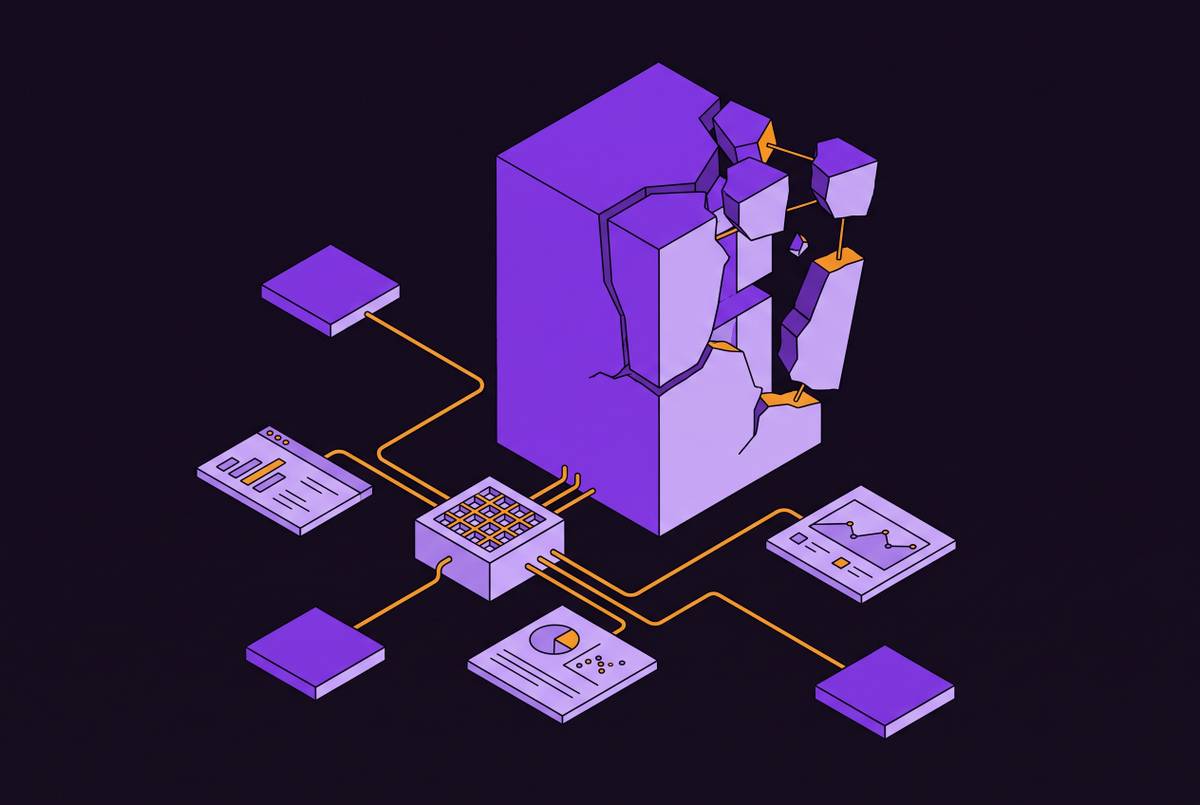
As agent count grows, separate integrations recreate the N×M connector problem. Each agent-to-data pairing needs authentication, error handling, and monitoring, while any pairing that bypasses governance creates another surface for access leakage and metric drift. Work on each integration becomes a question of who owns what across the whole system. A single governed layer instead gives agents one access-controlled interface without requiring a new production credential pattern for every addition.
Metric consistency is also a scaling property. When sales, finance, and product maintain separate versions of ARR, disagreements about definitions become disagreements about reported performance. Agents can reproduce that fragmentation just as readily as dashboards or engineers. A single governed definition removes competing implementations of the metric from the query path, freeing teams from reconciling calculations so they can debate decisions.
For founders and growing teams without a dedicated data team, a managed governed layer places the analytical copy, metric definitions, and agent-safe access surface under infrastructure management. Business judgment stays with the team. The layer takes responsibility for the plumbing that would otherwise become a recurring engineering task. MCP’s move to the Agentic AI Foundation under the Linux Foundation also keeps protocol governance vendor neutral, separating the common access protocol from the choice of managed implementation.
The objection that one or two agents do not justify a governed layer mistakes current traffic for future access structure. A credential pattern that works for a handful of agents can still create dangerous standing privileges as adoption grows. The boundary is easier to establish before that access accumulates. The architectural choice is therefore not how many direct integrations can be maintained today, but whether adding an agent should also add a production access path and another definition of the business.