Operational Analytics Architecture for AI-Native Startups
Autonomous agents need fresh, governed data layers to act safely—not direct database access.
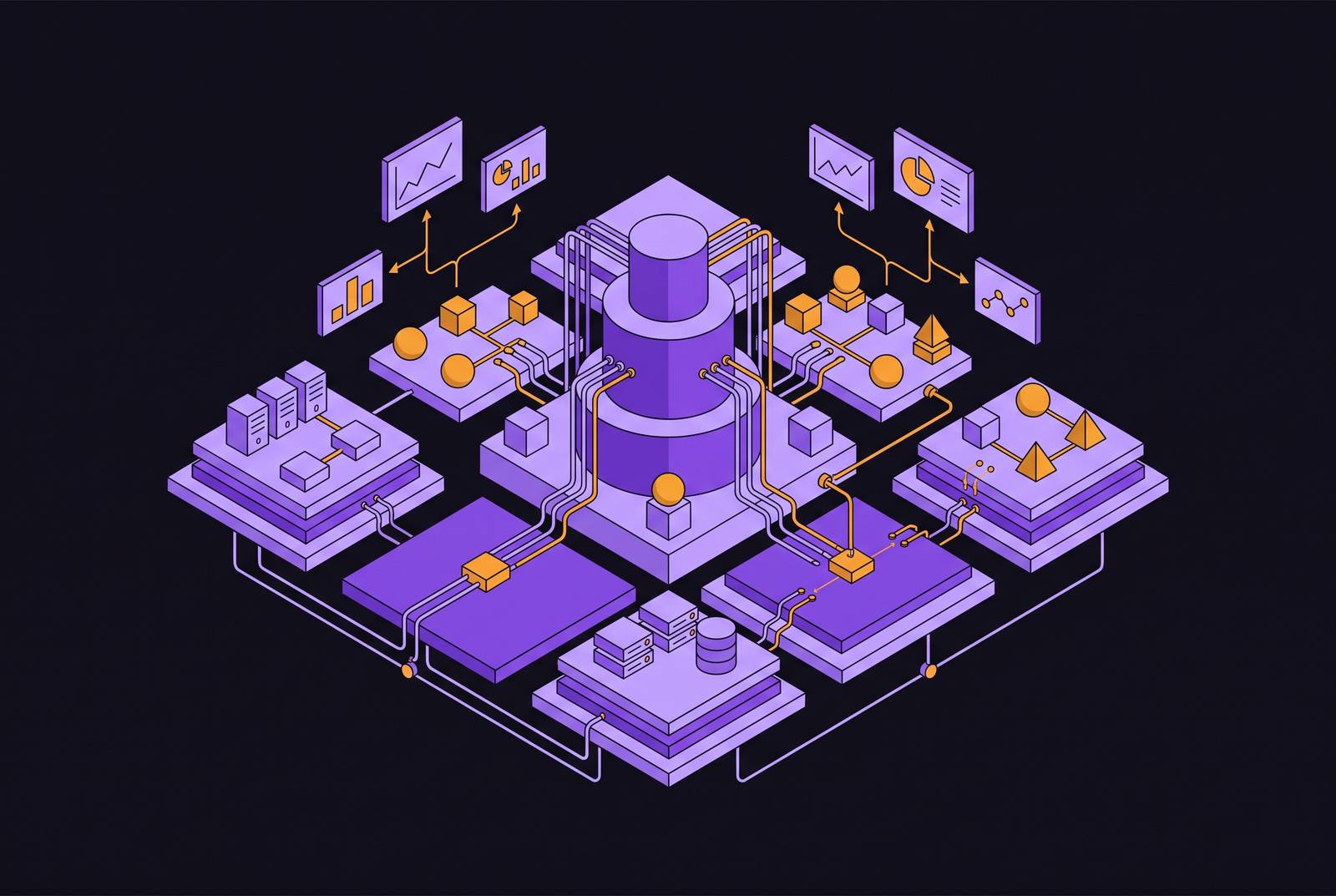
Operational analytics architecture for AI-native startups must serve people and autonomous agents from the same trusted data. It is built on a single governed data layer that has pre-modeled datasets, shared metric definitions, and access controls that are enforced. Production agents need more than direct access to live databases or batch-refreshed warehouses alone can give them.
Why the traditional analytics stack breaks when agents enter the loop
A support agent tells a customer that a package is in transit when it has already been delivered. The agent confidently answers using stale data. A financial agent that uses outdated positions runs into the same failure. In both cases, the agent can reason correctly about the information it receives and still act on the wrong number. In a batch-refresh warehouse, what the data records can lag behind what is happening now, and reasoning cannot close that gap.
Ambiguous data creates a second failure path. A human analyst can ask a colleague what a column means, wait for an export, or flag uncertainty before making a recommendation. An autonomous agent starts cold, chooses a table, and acts without necessarily surfacing doubt. More compute or a better model does not establish which source holds the answer, what its columns mean, or which numbers the agent may use.
The inherited stack was built for two more predictable consumers, namely pipelines and people. Pipelines are versioned and reviewed, while people have defined roles and leave audit trails. Agents are non-deterministic and traverse data at speeds no human can monitor. Production analytics cannot count on people to step in when agents work this way.
What agents actually need from a data layer, and why it is different from what analysts need
Agent-ready infrastructure must meet four requirements, which are freshness, semantic grounding, governed access, and reproducibility. Freshness means that derived views stay current independently of batch refreshes. An up-to-date source is not enough if the calculation presented to the agent still reflects an earlier state. The requirement applies to the data the agent actually consumes.
Semantic grounding must also arrive before query time. Agents need structured context covering table definitions, ownership, freshness state, access rules, and metric definitions before they reason. Discovering those details mid-query leaves the agent to resolve business ambiguity through inference. Governed access sets a separate boundary, with scoped, auditable permissions enforced at the data layer. Agents should not receive production database credentials.
Reproducibility completes the requirements because a decision must remain traceable after it has been made. Lineage records where the data came from and how it changed before reaching the agent. What these controls need to do depends on whether access is read-only, task-based, workflow-oriented, or cross-system. Cross-system work adds heterogeneous systems and controlled access across them, so an architecture designed only for isolated reads does not cover the full production workload.
Why letting agents query production Postgres directly is an authorization problem, not an alignment problem
The OAP pre-action authorization paper names the central gap as the “pre-action authorization problem”. Model alignment operates probabilistically through training, while post-hoc evaluation examines behavior retrospectively. Neither enforces a declarative policy before a tool call executes. The paper describes agents as having passwords but no permission slips. In its adversarial testing, social engineering worked under a permissive policy, while a similar group of attackers had zero success under a restrictive pre-action policy.
The OAP paper also documents failures that illustrate why permission cannot depend on model behavior. A red-teaming study with six autonomous agents found that reframing a single verb caused agents to leak SSNs, and agents destroyed their own infrastructure to protect secrets. A supply-chain attack placed prompt injection payloads and token exfiltration routines into a large share of a public skill registry. Thousands of exposed instances had conditions that allowed authentication bypass. These cases concern what systems allow agents to do.
For Supabase teams, connecting an AI tool with the postgres superuser role bypasses Row Level Security entirely. Session-level permission is also not enough because each action must be checked against what is in the request, what actions came before it, and the current business context. The correct pattern combines purpose-specific, least-privilege roles with ABAC, row-level filtering, and column-level masking. A fraud-detection agent can then get transaction amounts without getting payment card numbers.
The governed data layer — what it is and how it works as the single serving tier for humans and agents
A governed data layer is a single serving tier of pre-modeled, pre-calculated datasets with semantic definitions, enforced access controls, and a stable query interface. Its purpose is to resolve meaning and permission before either a person or an agent consumes the result. Keeping its derived datasets current addresses the freshness requirement. Pre-calculation alone does not remove staleness.
The layer has three interlocking components. Pre-modeled datasets hold metrics and dimensions calculated ahead of time, with Parquet queryable through DuckDB as one practical pattern. A semantic layer holds definitions, dimensions, relationships, ownership, freshness state, and lifecycle status. Policy enforcement makes the data layer apply permissions, masking rules, and access constraints, so each application does not have to apply them itself. Together, these components give consumers both a defined answer and an authorized path to it.
Agents can then query a model without having to work out what raw tables mean on their own. This architecture is “headless analytics”, combining semantic context and query access in a serving layer decoupled from any particular front end. Like a headless CMS separating content from presentation, it separates analytics infrastructure from the dashboard tool. A Slack bot, board dashboard, background agent, or founder’s phone can consume the same governed data through MCP or an API.
MCP as the interface layer — and why governance still lives underneath it
MCP standardizes how agents call tools and access resources, but it does not replace the platform underneath. It separates three participants, namely the host, client, and server. The host is the AI application, and its client manages a 1:1 connection to a server. The server exposes tools, resources, and prompts while connecting to databases, APIs, or internal tools.
The 2026-07-28 MCP specification release candidate drops session state from the core, which allows horizontal scaling and standard HTTP routing. Operationally, that changes how servers can route requests without maintaining protocol sessions. It does not make a request authorized merely because it reaches the right server. Governance still needs explicit implementation in the server’s exposed resources.
The U.S. National Security Agency’s May 2026 Cybersecurity Information Sheet warned that MCP’s rapid adoption had outpaced development of its security model. The OAP paper documents hundreds of production MCP servers exposed without authentication or encryption. Adoption therefore cannot stand in for safety. MCP’s architectural boundary limits access to governed datasets.
How Supabase teams should separate transactional and analytical workloads before agents arrive
Postgres is not a warehouse, and large analytical scans can degrade transactional latency. Supabase teams should send read-heavy and analytical queries to read replicas, keeping that traffic off the production primary. Materialized views should pre-compute expensive results that agents and dashboards request repeatedly. Index design should follow real query patterns and be tested early, before latency becomes a production problem.
RLS policies should remain simple and be tested against realistic data volumes because policy complexity becomes a performance cost at scale. Connection pooling supports serverless patterns in which agents issue frequent short queries that would otherwise exhaust connection limits. Archiving cold data keeps tables that grow all the time from holding every historical record in the active workload. A dedicated analytics database role with appropriate RLS policies establishes the access boundary for AI analytics.
Supabase’s Analytics Buckets, built on Apache Iceberg, let teams offload large datasets into queryable analytical storage. They support time-travel queries while keeping the transactional database lean. For vector features, pgvector in the same Postgres instance is appropriate below a workload-dependent vector-count threshold. Above it, IVFFlat and HNSW indexes still work, but drifting query latency can make a dedicated vector store worth the operational cost. The central decision remains workload separation, with Postgres retained as the transactional home.
One metric definition, shared across every stakeholder — why the semantic layer is the startup's most valuable data asset
Two teams can enter the same meeting with different definitions of ARR and spend the meeting reconciling numbers, delaying decisions. That failure is more consequential than a missing dashboard because it undermines the shared basis for action. When sales, finance, and product maintain separate calculations, leadership inherits their disagreement. A single source of truth therefore means one definition, one calculation logic, and one governed place where the metric lives.
A wiki page can document agreement, but it does not make every consumer execute the same calculation. The semantic layer operationalizes that agreement by translating raw data into business metrics, including MRR and LTV. A calculation changes once and propagates to human dashboards and agent queries alike. An agent that bypasses this canonical definition can calculate its own version and act on the divergence without flagging it. Shared semantics are consequently a leadership control.
The CEO’s metric set can remain small. Revenue includes ARR, new ARR, and growth rate, while retention includes gross retention, net retention, and logo churn. Efficiency covers gross margin, CAC payback, and magic number. The cash metrics are runway and monthly burn, and the product metrics are weekly active accounts and the key activation metric. More dashboard metrics do not repair inconsistent definitions and can instead bury the signal in unread noise.
When to introduce data governance, and what it looks like at each stage of a startup's growth
Deferring governance moves the work into a later period when more data, policies, and business decisions depend on the existing arrangements. At seed stage, the foundation is shared understanding, with one agreed definition for each core metric written down and accessible to the team. Formal tooling is not required at that point. The discipline is to establish a canonical definition before competing versions become embedded in daily decisions.
As the startup gets closer to product-market fit, shared understanding grows into formal stewardship. That means written steward responsibilities, a lightweight process for production data access, and governance KPIs that are actually tracked. At scale, ABAC, audit trails, column-level masking, and agent-specific access controls become non-optional. The data is then consequential enough that a governance failure is a business failure.
Rebuilding pipelines and rewriting policies at Series B costs more time and money than establishing the foundation at seed. The later rebuild also happens under investor scrutiny and against a much larger dataset. Autonomous agents compress that timeline further. Deploying the first agent without a governed data layer effectively moves a startup into the at-scale threat model, regardless of its ARR.
The operational architecture in practice — what a governed data layer looks like end-to-end for a Supabase team
For a Supabase team, the end-to-end pattern starts with Postgres remaining the transactional source. Read replicas take analytical traffic away from the primary, while materialized views pre-compute repeated reads. The modeling layer turns source data into governed Parquet datasets queryable through DuckDB. Metrics are calculated once for analytical consumption rather than reconstructed independently by every downstream tool. The semantic layer supplies the definitions, dimensions, ownership, freshness state, and access rules that make those results usable.
Purpose-specific roles, ABAC with row-level filtering, and column-level masking constrain access at the data layer. Agents receive governed query access. A single MCP server exposes the datasets to authorized consumers, including a founder’s dashboard, a Slack digest, a background analytics agent, and a board report. Those consumers use the same pre-calculated numbers, with each limited to what its permissions allow. That serving contract unifies the architecture.
At the MCP boundary, pre-action authorization evaluates every attempted tool call against a declarative policy before execution and produces a cryptographically signed audit record. The OAP paper presents this synchronous enforcement pattern as complementary to sandboxed execution and model-based screening. Agents can query modeled datasets and get semantic context before they reason, but they cannot reach production databases or get rows and columns that their policy scope does not allow.